Guest Post! Beyond the Acceptance Letter: Why the First 90 Days of College Matter for Long-Term Career Success

Guest Post! Beyond the Acceptance Letter: Why the First 90 Days of College Matter for Long-Term Career Success

The deposit is paid. The college sweatshirt may already be ordered. For many families, late spring feels like the finish line after a long and demanding admissions process. But once the decision is made, a new question quickly takes its place: Now what?

This is where many families feel uncertain. They have spent so much time focused on getting into college that they’ve had little reason to think about what happens next. Yet the first few months of college shape far more than students realize. They influence confidence, habits, relationships, and the foundation for future internships and job opportunities.

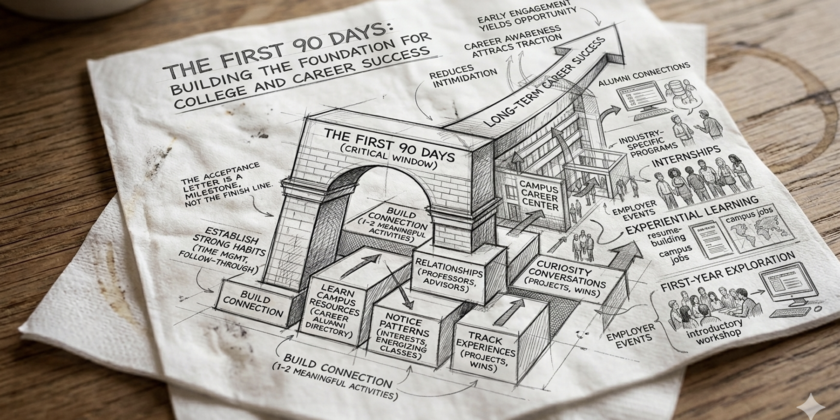
Research on the college transition often points to the first several weeks as a critical window. Students who build connections, learn how to use campus resources, and establish strong habits early are more likely to stay engaged and make the most of later opportunities. That doesn’t mean an incoming freshman needs a full career plan. They don’t. But it does mean families should start thinking earlier about how a student will use college, not just where they will go.

The acceptance letter is a milestone, not the finish line

Getting into college matters. It reflects years of effort, growth, and persistence. It is a real accomplishment and should be celebrated.

At the same time, admission is only the beginning. A college education is not simply a four-year academic experience. For most families, it is also a major financial investment tied to future opportunity. That’s why it helps to shift the conversation from “Where did my student get in?” to “How will my student make the most of this experience?”

College is not just a place to earn credits. It is also where students build relationships, experiences, and habits that shape future opportunities. Students who begin college with even a basic level of career awareness often gain traction faster. Not because they have everything figured out, but because they begin noticing what interests them, where they fit, and what experiences will help them build momentum.

The career center is not just for seniors

One of the most common myths on college campuses is that career services are for juniors and seniors ready to apply for jobs. In reality, the students who benefit most are often the ones who engage early. A first-year student does not need to walk into the career center and ask for a job. They can simply learn what is available. That might mean attending an introductory workshop, reviewing resources, or asking basic questions about resume-building, campus jobs, internships, alumni connections, or career exploration tools.

It’s also worth learning what platforms and systems the school uses. Does the college post opportunities through Handshake? Is there an alumni directory that students can access? Are there employer events, career fairs, or industry-specific programs first-year students can attend?

This matters even more now because many internship and recruiting timelines begin earlier than families expect. Students don’t need to start job hunting in their first semester, but they do benefit from understanding the landscape sooner rather than later. Early exposure also reduces intimidation. Students who wait until they urgently need help are often starting from scratch at the exact moment pressure is highest. Students who get familiar with available resources in the first semester are far more likely to use them when it counts.

Build a strong foundation without over-planning

The goal of the first 90 days is not to lock in a major, choose a career, and build a five-year plan. That’s too much pressure and usually not realistic. A better goal is to build a foundation that makes future choices easier and stronger. That foundation starts with a few simple habits.

First, encourage your student to choose one or two meaningful activities rather than joining everything. Depth matters more than a long list. A club, organization, volunteer role, student publication, research project, or campus job can all become valuable if the student is engaged enough to learn from it and contribute. These experiences also build something just as important as a resume line: a sense of belonging. Students who feel connected early are more likely to stay engaged, seek support, and hear about future opportunities.

Second, relationships matter early. Professors, advisors, resident assistants, older students, and campus staff can all become sources of insight and encouragement. Students don’t need a polished agenda. They just need to get comfortable asking questions, seeking guidance, and paying attention.

Third, students should begin noticing patterns. What classes are energizing? What problems do they enjoy solving? What kinds of people and environments bring out their best? Early self-awareness is often more useful than premature certainty.

Finally, it helps to keep track of experiences and accomplishments as they happen. One simple habit can pay off later: keep a running note of projects, responsibilities, software learned, problems solved, presentations given, and small wins along the way. Students rarely remember these details later, but they become the raw material for future resumes, LinkedIn profiles, networking conversations, and interviews.

Academic habits are part of career readiness

Parents often think of academic success and career readiness as two separate tracks. In reality, they’re closely connected.

The first semester is when students establish habits around class attendance, time management, help-seeking, and follow-through. Those habits affect grades, confidence, and stress levels. They also shape access to future opportunities. A strong GPA is not everything, but in some fields it matters. More broadly, students who learn how to manage college well are in a much better position to pursue internships, campus leadership, research, and networking later on.

That’s why the first 90 days are about more than career planning. They’re also about building the routines that make long-term progress possible.

Encourage curiosity conversations early

One of the most useful things a student can do in the first semester is start having what I call curiosity conversations. Networking can feel intimidating to a freshman. Curiosity conversations are a lower-pressure way to begin. These are informal conversations with alumni, older students, family friends, professors, or professionals in fields that sound interesting. The purpose is not to ask for a job or internship. It is simply to learn. What does this person do? How did they get there? What surprised them about college or work? What advice would they give someone starting out?

These conversations help students gain exposure to possible paths, build confidence talking with professionals, and understand how college experiences connect to real-world opportunities. Curiosity conversations are a low-pressure way to start building momentum.

What high school families should look for now

For families still making a final college choice, this is a good time to ask better questions about each school’s career ecosystem. Look beyond the admissions brochure. Ask about internship support, alumni engagement, access to employers, career center programming, experiential learning, and outcomes for students in different majors. A college’s value is not just about prestige or fit in the abstract. It is also about how well the school helps students translate education into opportunity.

What incoming students and parents should focus on next

For incoming college students, the message is simple: start with exploration, but be intentional. You don’t need to map out your life this summer. You do need to enter college ready to engage. Show up. Ask questions. Try things. Build a few relationships. Learn what support exists. Notice what fits. Keep track of what you do. Those early habits create options later.

For parents, this is also a mindset shift. During the admissions process, you may have needed to be more hands-on. Once college begins, your role works better as a guide than a manager. That means asking thoughtful questions, encouraging follow-through, and helping your student reflect without taking over.

Some students arrive on campus with plenty of ambition but little clarity on how to connect majors, activities, interests, and early career steps. That is normal. It is also where outside guidance can make a difference. Sometimes students benefit from structured support that helps them move from good intentions to a real plan.

The first 90 days matter, but progress matters more than perfection. Students do not need to get everything right immediately. What matters most is building a foundation early and making thoughtful adjustments along the way. The acceptance letter opens the door. What students do in the first 90 days helps determine how much they gain from walking through it.

Christine Rigby-Hall is the Founder of GradLanding, a coaching practice that helps college students and early career professionals build direction, confidence, and momentum in the internship and job search process.

If your student is heading to college with ambition but not much clarity about how to connect majors, activities, and early career steps, GradLanding offers practical support to help students build a stronger foundation from the start.

*Stay in the know! Subscribe*
Finding Summer Research Opportunities When Programs Are Full (or You’re Not Admitted To A Formal Program)

Finding Summer Research Opportunities When Programs Are Full (or You’re Not Admitted To A Formal Program)

At this point in the year, many formal summer STEM programs have closed their applications. However, many of the strongest STEM applicants pursue another path: independent research with professors or in research labs. This is a very common route for students who later apply to selective STEM programs and universities.

Most research opportunities are not publicly advertised. They often happen because a student reaches out thoughtfully and demonstrates genuine curiosity. Below is a guide to help you try to make this happen.

1. Identify the right type of lab

Focus on universities, research hospitals, or research institutes near you. Professors are much more likely to work with students who can participate locally and can show up if needed. Good places to look include:

  • University department websites (physics, engineering, computer science, psychology, human development, kinesiology, math)
  • Research labs within those departments
  • Medical research institutes
  • National labs or science centers

When researching labs, look for work that genuinely interests you, rather than emailing randomly.

2. Read a little about their research

Before emailing a professor, spend some time learning about their work. This step helps your message stand out. Try to:

  • Read the lab’s website or research description
  • Skim one or two recent research papers
  • Understand the general goal of its research

You do not need to understand everything. The goal is to show you took the time to learn about their work.

3. Send a short, thoughtful email

When you reach out, express curiosity and ask whether there may be opportunities to learn or assist with research. A strong outreach email usually includes:

  • Who you are (grade, school, academic interests)
  • What specifically interested you about their research
  • Any relevant coursework, projects, or activities
  • A polite request to learn more or potentially assist

Professors often respond well to students who show initiative and intellectual curiosity, even if the role begins in a small way. Common starting points include:

  • Shadowing
  • Assisting a graduate student
  • Helping with data collection
  • Reading research papers and attending lab meetings
  • Completing a small independent project within the lab

4. Email more than one lab

It is normal to contact 10–20 labs before finding an opening. Professors are busy, and many will not respond. Persistence is part of the process.

5. Be open to starting small

Most high school researchers begin with foundational tasks such as:

  • Data entry
  • Literature reviews
  • Coding assistance
  • Building or testing equipment
  • Running simulations

While these may seem small at first, they often lead to:

  • Longer term mentorship
  • Deeper research projects
  • Sometimes, conference presentations or co-authorship

6. Start now, don’t wait

March and April (even into early May!) are the best times for securing summer research opportunities. Labs are often flexible if:

  • A graduate student is willing to supervise
  • You demonstrate strong initiative
  • You won’t need extensive training

In many cases, students work most closely with a graduate student mentor, rather than directly with the professor.

7. What makes someone say yes

Professors are most likely to respond to students who demonstrate:

Initiative — reaching out after learning about the lab
Genuine curiosity — not simply résumé building
Basic preparation — relevant classes, independent research/projects, competitions, etc., all made clear to them

*Stay in the know! Subscribe*

Fit > Prestige

Fit > Prestige

Jeff Selingos’ recent NYT article highlights an often overlooked truth about college admissions: colleges are businesses.

“Elite colleges have convinced us that scarcity equals quality, that a lower acceptance rate means a better education. But their own behavior shows that many of their decisions are more about manipulating the market than academic or any other kind of excellence.”

Everyone needs to start valuing fit over prestige, because only then can we break free of the hold elite colleges have on many of us.

Jeff Selingo’s new book is out, and there’s also a recent interview with the CB Mentor that covers most of the big-ticket items, but it’s also worth a read! Interview here: https://www.youtube.com/watch?v=h-QViIKGcDc

Some takeaways:

-Rank and selectivity are seen as a proxy for quality among parents, and they are not

-You can get a very good deal at less selective schools (merit = tuition discount), where quality and career outcomes are high

-Give yourself permission to widen your lens on the college search!

*Stay in the know! Subscribe*


Free SAT Bootcamp

Free SAT Bootcamp

Time to prep! Sharing a free program via Schoolhouse.

SAT Bootcamps: 4-week program kicking off on September 5th (schedule selected by student)
  • Perfect for students taking the Oct. 4th SAT
  • Students can choose between Math or Reading & Writing, or take both
  • They’ll meet with a small group of students and a peer tutor twice a week

*Stay in the know! Subscribe*

Uptown Psychology’s Fall Executive Functioning Intensives

Uptown Psychology’s Fall Executive Functioning Intensives

As the school year gets underway, now is the time to address the executive functioning challenges that can impact your child’s academic and emotional success.

Uptown Psychology’s Fall Executive Functioning Intensives are designed to help children, teens, and young adults build the skills they need to stay focused, organized, and confident throughout the year. Now is the time to solidify these before returning to school. Intensives support students who struggle with:

✅ Staying organized and managing time
✅ Starting and completing tasks
✅ Regulating emotions and attention
✅ Planning ahead and following routines

Led by licensed therapists and former teachers, this structured, evidence-based program includes:

🧠 Individualized skill-building based on each student’s strengths and needs
📅 Short-term, goal-focused sessions that fit into busy school schedules
💻 Flexible options for in-person or telehealth participation
📍 Convenient Upper East Side or available virtually

Whether your child is navigating new academic demands or long-standing executive functioning challenges, UP’s executive function intensives can provide the support they need to succeed.

Learn more by booking a 15-minute consultation here!

Resume Magic

Resume Magic

What selective colleges look for in applicants is fairly well known. Academic excellence in your school’s most rigorous classes is a start, as are competitive test scores. But many applicants overlook the magic that happens when what excites you in the classroom begins to show up in what you do outside of it. This is how you demonstrate that you have a curious mind, some intellectual spark. As Michigan says, “Show us how the combination of coursework and related activities inspired original thinking on your part.” These connections light up the eyes of AdComs at the most selective colleges.
 
I also want to point out something Princeton says that really highlights why your resume matters so much in this process, as they seek to “understand your potential to take advantage of the resources at Princeton and the kind of contribution you would make to the Princeton community.” What you do in high school foreshadows what you might do in college. When you look at your resume, is that picture clear, and does it include academics? College is school, after all…. 
 
You don’t need to be applying to Princeton, Yale, or Michigan to benefit from this advice: 
 

Yale podcast/blog: https://admission.princeton.edu/blogs/testing-rigor-ai-and-what-are-we-really-looking-your-questions-answered-dean-richardson

Michigan’s application instructions: https://admissions.umich.edu/apply/first-year-applicants/selection-process

Princeton’s helpful tips: https://admission.princeton.edu/apply/before-you-apply/helpful-tips

 
*Stay in the know! Subscribe*

Common App Essay Tip: Writer’s Block

Writer’s block is no joke! It happens to the best of us, so don’t get too frustrated if some days you just can’t get in the groove with your writing. When it strikes, try using these ideas to help jumpstart the process:

  1. Remove all distractions: Put your phone in the other room, close out all the browsers on your computer, close the door, put on some headphones, give your laptop to your parents, and spend an hour with just pen and paper.
  2. Set a timer: Don’t spend hours staring at the screen. After removing all distractions, set a timer for 20 minutes and follow the next step.
  3. Write like nobody’s watching: The college process can feel high stakes, and the pressure can make you feel like every word you put down has to be perfect. If you get stuck, try to “just write.” Forget that you’re writing a college admissions essay; imagine you’re writing a diary entry or a letter to your best friend instead. You can even use bullet points if writing sentences seems too intimidating right now! You can repeat this exercise as many times as needed.

If you aren’t getting anything down in 20 concentrated minutes, it might be time to skip to 4 and 5.

  1. Change of scenery: Maybe you are used to doing all of your writing at your desk or kitchen table or bed or parent’s office. Change it up from time to time, especially if you feel stuck. You might find that the local library or coffee shop, or maybe even a WiFi-free setting like the park, is the place where you really get in the zone. You won’t know until you do some exploring.
  2. Try this mantra: You CAN write your college application essays, and you WILL write them. Take this on as your mantra—or come with your own—then write it on an index card and tape it above the space where you usually work.

Ultimately, the only way to get over writer’s block is… to write! You can do this!

*Stay in the know! Subscribe*

Common App Essay Tip: Approaching Topic Choice

Common App Essay Tip: Approaching Topic Choice

Your personal statement should uniquely reflect who you are, what you value, and how you think—while also engaging and even surprising the reader.

You may be thinking, “Nothing much has happened to me! How can I surprise the reader?” Well, one of the biggest myths about the personal statement is that you can’t write a good one unless you have a “big” or tragic story to tell: “I was on my way to becoming a professional skater before I shattered my ankle,” or “I overcame a life-threatening disease then founded my own nonprofit to fund research on that disease.” While an experience like this could make for an excellent (though painful) personal statement, it could also make for…a boring essay. Although it’s sad to say, admissions officers have read many of these stories and therefore aren’t surprised or even moved by them.

Just think about it: admissions officers read thousands of essays every year, year after year. To get through them all, they have to read quickly, stopping once they figure out which “pile” you belong in (yes, no, or maybe). Your goal is to force that reader to slow down, even stop—to make them want to read your essay, to make them think, “I’ve never seen this before!” Admissions officers are more likely to have seen the “big” stories before—every year, they read thousands of essays about sports injuries and divorces, about Eagle Scout projects and difficult classes. Often, the best way to surprise the reader is to think small—to write about an unusual hobby (Sample Essay 6 in The Complete College Essay Handbook) or passion (Sample Essay 5 in The Complete College Essay Handbook)—or to write about a more common experience in an unexpected way, like discussing your parent’s divorce in the context of a violent protest (Sample Essay 4 in The Complete College Essay Handbook). Surprise can also be contextual. A varsity soccer player writing about varsity soccer? Not surprising.

A note: not all surprises are created equal. There is the pleasant, gentle “surprise party” kind of surprise, and then there is shock, which can be invoked through violent images or vulgar confessions, and which produces negative emotions—fear, disgust, anger, and more.

And…not all topics are created equal: some are very common and therefore boring, while others are too complicated to tell in 650 words or highlight privilege. You might want to reconsider writing about these for the CA essay:

  • Academic performance (test prep, getting an “A” in a hard class)
  • The college admissions process
  • Death of a grandparent or a favorite pet
  • Events your parents or grandparents lived through before you were born
  • Service trips abroad
  • Sports and sports injuries
  • Drama in your friend group
  • What you did the summer before 12th grade
  • A story that begins and ends before 8th grade—i.e. “When I was 10, this thing happened, and it changed me in these ways. The end.”

Occasionally, students do have exceptional stories within these topics. For instance, maybe your grandmother raised you as if you were her own child and so her death hit you particularly hard, or maybe your parents’ stories of living through the fall of the Soviet Union sparked your consuming passion for history, or maybe failing trigonometry truly changed your life. Trust yourself to know if your story falls into one of these exceptional categories, and ask a friend if you aren’t sure.

That said, there are a few topics you should never ever write, for the personal statement or the supplemental essays, about because they act as red flags to admissions readers and will likely prevent your application from being seriously considered. These include:

  • Sex
  • Drugs/alcohol
  • Rock n’ Roll (just kidding… this is fine, actually, we welcome it!)
  • Serious and unresolved mental health issues
  • Actual or borderline criminal behavior
  • Extremely controversial ideas or beliefs (in conspiracy theories, for instance)

Note that all of these are only red flags if they are about you—your mental health issues, your consumption of drugs or alcohol, your controversial beliefs. It is fine to write an essay that engages with one of these topics from a distance (e.g., your brother was an alcoholic, a friend pressured you to engage in risky behavior, but you refused) so long as you are still writing about your experience of that situation.

*Stay in the know! Subscribe*

What’s The Common App Essay All About?

The school year is winding down, which means it’s time to start working on college admissions essays. This month, we’ll share some excerpts from our book, The Complete College Essay Handbook, starting with some personal statement tips!

First, what exactly is a personal statement like the Common Application essay?

A personal statement is a creative essay of 650 words or less that reads like a short story, memoir, or novel—not like an academic essay, textbook, or newspaper article. The best personal statements tell a story that culminates in a meaningful realization and offers the reader a glimpse of a mind in the process of thinking.

The personal statement is not the place to brag about accomplishments (student body president, team captain, founder of a schoolwide service project), or about how amazing you are (“I’m a world-changing revolutionary!”).

Although people you don’t know are going to read it, the personal statement is not a public form, like a school-wide speech. The personal statement is an intimate form, like a secret. It is the place to be honest, vulnerable, and raw, to reveal mistakes and weaknesses, to open up about an experience you’d only tell someone you were really close with, to explore what you struggle with and what scares you.

The personal statement is not “about” an event or achievement. It is about the psychological and emotional processes that occurred “behind the scenes.”

The same story, told from one angle, can be impersonal whereas, from another—told with a focus on the process rather than the outcome—can become deeply personal. Here are a few examples to help explain what I mean.

  • NO (Impersonal): The story about how you got elected student body president and a detailed account of everything you plan work on once in office
  • YES (Personal): The story about your internal struggle to overcome a crippling fear of public speaking in order to run for student body president
  • NO (Impersonal): The story about how you changed lives by raising money for an orphanage in Africa
  • YES (Personal): The story about how you decided to start raising money for an orphanage because you yourself had been adopted and always struggled with the fact that your birth parents had abandoned you
  • NO (Impersonal): The story about how tearing your ACL was hard because you couldn’t play football or see your friends for a few months
  • YES (Personal): The story about how tearing your ACL gave you the time to reflect on who you are and you realized you didn’t want to just be an athlete so you started writing poetry and made new friends at school

Notice how all of these negative examples focus on the superficial event: I was elected; I raised money; I tore my ACL. By contrast, the positive examples explore the story behind the event—what was going inside of the writer that either led to this event (the student body president and orphanage examples) or the internal change that resulted from it (the ACL example). They also explore intimate, potentially difficult topics.

Since the personal statement is a creative essay at its heart, there is no set formula for success—however, our process and essay samples will give you the tools and examples you need to write your own standout personal statement.

*Stay in the know! Subscribe*

Talking To Teens About College

Talking To Teens About College

The college process often amplifies anxiety among teens and their parents, yet stress is inevitable. The goal is to manage it healthily, according to Lisa Damour, a clinical psychologist, author of The Emotional Lives of Teenagers, and host of the Ask Lisa podcast.

Lisa joined Jeff Selingo on a special 30-minute edition of “Next Office Hour” last week. Let’s all give the episode a listen. Some top takeaways:

Accept discomfort. Parents should acknowledge emotional stress as normal. “We cannot prevent emotional pain in our teenagers. Rather, we should help them manage discomfort when it comes,” Damour said. The focus should be on helping teens cope constructively, like allowing space for healthy distractions or emotions rather than harmful habits

Encourage healthy coping. Crying, spending time with friends, physical activity, and mindful rest are all beneficial ways teens can process stress. Parents should be alert only when teens use costly coping mechanisms like substance use or self-criticism.

Reframe high school. Teens should focus on cultivating genuine interests and strengths rather than solely trying to impress admissions officers. Enjoying downtime without guilt is crucial for mental health.

Recognize parental roles. I loved Lisa’s analogy of the Pit Crew vs. the Tow Truck. Parents often feel pulled between supporting their kids (pit crew) and pushing them (tow truck). Constant towing suggests a teen may not be ready for college, highlighting the value of considering gap years or alternative pathways.

Dealing with rejection. College admissions isn’t always meritocratic. When teens face rejection, validate their feelings but emphasize they’ll thrive by focusing on what they can control.

The big picture? Parents and teens often overestimate how much college prestige matters.

If you don’t follow Jeff Selingo, you should. See past issues and subscribe to his newsletter. You can also find him on LinkedInInstagramFacebookTwitter, and Threads if social is your thing!

*Stay in the know! Subscribe*