Blog

Guest Post! Beyond the Acceptance Letter: Why the First 90 Days of College Matter for Long-Term Career Success

Guest Post! Beyond the Acceptance Letter: Why the First 90 Days of College Matter for Long-Term Career Success

The deposit is paid. The college sweatshirt may already be ordered. For many families, late spring feels like the finish line after a long and demanding admissions process. But once the decision is made, a new question quickly takes its place: Now what?

This is where many families feel uncertain. They have spent so much time focused on getting into college that they’ve had little reason to think about what happens next. Yet the first few months of college shape far more than students realize. They influence confidence, habits, relationships, and the foundation for future internships and job opportunities.

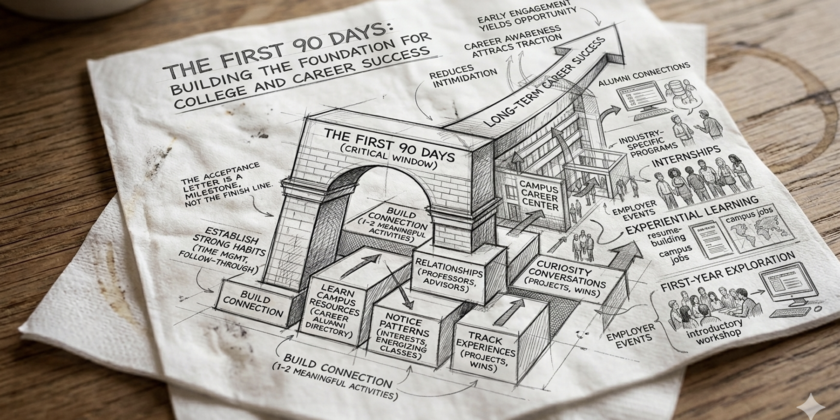
Research on the college transition often points to the first several weeks as a critical window. Students who build connections, learn how to use campus resources, and establish strong habits early are more likely to stay engaged and make the most of later opportunities. That doesn’t mean an incoming freshman needs a full career plan. They don’t. But it does mean families should start thinking earlier about how a student will use college, not just where they will go.

The acceptance letter is a milestone, not the finish line

Getting into college matters. It reflects years of effort, growth, and persistence. It is a real accomplishment and should be celebrated.

At the same time, admission is only the beginning. A college education is not simply a four-year academic experience. For most families, it is also a major financial investment tied to future opportunity. That’s why it helps to shift the conversation from “Where did my student get in?” to “How will my student make the most of this experience?”

College is not just a place to earn credits. It is also where students build relationships, experiences, and habits that shape future opportunities. Students who begin college with even a basic level of career awareness often gain traction faster. Not because they have everything figured out, but because they begin noticing what interests them, where they fit, and what experiences will help them build momentum.

The career center is not just for seniors

One of the most common myths on college campuses is that career services are for juniors and seniors ready to apply for jobs. In reality, the students who benefit most are often the ones who engage early. A first-year student does not need to walk into the career center and ask for a job. They can simply learn what is available. That might mean attending an introductory workshop, reviewing resources, or asking basic questions about resume-building, campus jobs, internships, alumni connections, or career exploration tools.

It’s also worth learning what platforms and systems the school uses. Does the college post opportunities through Handshake? Is there an alumni directory that students can access? Are there employer events, career fairs, or industry-specific programs first-year students can attend?

This matters even more now because many internship and recruiting timelines begin earlier than families expect. Students don’t need to start job hunting in their first semester, but they do benefit from understanding the landscape sooner rather than later. Early exposure also reduces intimidation. Students who wait until they urgently need help are often starting from scratch at the exact moment pressure is highest. Students who get familiar with available resources in the first semester are far more likely to use them when it counts.

Build a strong foundation without over-planning

The goal of the first 90 days is not to lock in a major, choose a career, and build a five-year plan. That’s too much pressure and usually not realistic. A better goal is to build a foundation that makes future choices easier and stronger. That foundation starts with a few simple habits.

First, encourage your student to choose one or two meaningful activities rather than joining everything. Depth matters more than a long list. A club, organization, volunteer role, student publication, research project, or campus job can all become valuable if the student is engaged enough to learn from it and contribute. These experiences also build something just as important as a resume line: a sense of belonging. Students who feel connected early are more likely to stay engaged, seek support, and hear about future opportunities.

Second, relationships matter early. Professors, advisors, resident assistants, older students, and campus staff can all become sources of insight and encouragement. Students don’t need a polished agenda. They just need to get comfortable asking questions, seeking guidance, and paying attention.

Third, students should begin noticing patterns. What classes are energizing? What problems do they enjoy solving? What kinds of people and environments bring out their best? Early self-awareness is often more useful than premature certainty.

Finally, it helps to keep track of experiences and accomplishments as they happen. One simple habit can pay off later: keep a running note of projects, responsibilities, software learned, problems solved, presentations given, and small wins along the way. Students rarely remember these details later, but they become the raw material for future resumes, LinkedIn profiles, networking conversations, and interviews.

Academic habits are part of career readiness

Parents often think of academic success and career readiness as two separate tracks. In reality, they’re closely connected.

The first semester is when students establish habits around class attendance, time management, help-seeking, and follow-through. Those habits affect grades, confidence, and stress levels. They also shape access to future opportunities. A strong GPA is not everything, but in some fields it matters. More broadly, students who learn how to manage college well are in a much better position to pursue internships, campus leadership, research, and networking later on.

That’s why the first 90 days are about more than career planning. They’re also about building the routines that make long-term progress possible.

Encourage curiosity conversations early

One of the most useful things a student can do in the first semester is start having what I call curiosity conversations. Networking can feel intimidating to a freshman. Curiosity conversations are a lower-pressure way to begin. These are informal conversations with alumni, older students, family friends, professors, or professionals in fields that sound interesting. The purpose is not to ask for a job or internship. It is simply to learn. What does this person do? How did they get there? What surprised them about college or work? What advice would they give someone starting out?

These conversations help students gain exposure to possible paths, build confidence talking with professionals, and understand how college experiences connect to real-world opportunities. Curiosity conversations are a low-pressure way to start building momentum.

What high school families should look for now

For families still making a final college choice, this is a good time to ask better questions about each school’s career ecosystem. Look beyond the admissions brochure. Ask about internship support, alumni engagement, access to employers, career center programming, experiential learning, and outcomes for students in different majors. A college’s value is not just about prestige or fit in the abstract. It is also about how well the school helps students translate education into opportunity.

What incoming students and parents should focus on next

For incoming college students, the message is simple: start with exploration, but be intentional. You don’t need to map out your life this summer. You do need to enter college ready to engage. Show up. Ask questions. Try things. Build a few relationships. Learn what support exists. Notice what fits. Keep track of what you do. Those early habits create options later.

For parents, this is also a mindset shift. During the admissions process, you may have needed to be more hands-on. Once college begins, your role works better as a guide than a manager. That means asking thoughtful questions, encouraging follow-through, and helping your student reflect without taking over.

Some students arrive on campus with plenty of ambition but little clarity on how to connect majors, activities, interests, and early career steps. That is normal. It is also where outside guidance can make a difference. Sometimes students benefit from structured support that helps them move from good intentions to a real plan.

The first 90 days matter, but progress matters more than perfection. Students do not need to get everything right immediately. What matters most is building a foundation early and making thoughtful adjustments along the way. The acceptance letter opens the door. What students do in the first 90 days helps determine how much they gain from walking through it.

Christine Rigby-Hall is the Founder of GradLanding, a coaching practice that helps college students and early career professionals build direction, confidence, and momentum in the internship and job search process.

If your student is heading to college with ambition but not much clarity about how to connect majors, activities, and early career steps, GradLanding offers practical support to help students build a stronger foundation from the start.

*Stay in the know! Subscribe*
Finding Summer Research Opportunities When Programs Are Full (or You’re Not Admitted To A Formal Program)

Finding Summer Research Opportunities When Programs Are Full (or You’re Not Admitted To A Formal Program)

At this point in the year, many formal summer STEM programs have closed their applications. However, many of the strongest STEM applicants pursue another path: independent research with professors or in research labs. This is a very common route for students who later apply to selective STEM programs and universities.

Most research opportunities are not publicly advertised. They often happen because a student reaches out thoughtfully and demonstrates genuine curiosity. Below is a guide to help you try to make this happen.

1. Identify the right type of lab

Focus on universities, research hospitals, or research institutes near you. Professors are much more likely to work with students who can participate locally and can show up if needed. Good places to look include:

  • University department websites (physics, engineering, computer science, psychology, human development, kinesiology, math)
  • Research labs within those departments
  • Medical research institutes
  • National labs or science centers

When researching labs, look for work that genuinely interests you, rather than emailing randomly.

2. Read a little about their research

Before emailing a professor, spend some time learning about their work. This step helps your message stand out. Try to:

  • Read the lab’s website or research description
  • Skim one or two recent research papers
  • Understand the general goal of its research

You do not need to understand everything. The goal is to show you took the time to learn about their work.

3. Send a short, thoughtful email

When you reach out, express curiosity and ask whether there may be opportunities to learn or assist with research. A strong outreach email usually includes:

  • Who you are (grade, school, academic interests)
  • What specifically interested you about their research
  • Any relevant coursework, projects, or activities
  • A polite request to learn more or potentially assist

Professors often respond well to students who show initiative and intellectual curiosity, even if the role begins in a small way. Common starting points include:

  • Shadowing
  • Assisting a graduate student
  • Helping with data collection
  • Reading research papers and attending lab meetings
  • Completing a small independent project within the lab

4. Email more than one lab

It is normal to contact 10–20 labs before finding an opening. Professors are busy, and many will not respond. Persistence is part of the process.

5. Be open to starting small

Most high school researchers begin with foundational tasks such as:

  • Data entry
  • Literature reviews
  • Coding assistance
  • Building or testing equipment
  • Running simulations

While these may seem small at first, they often lead to:

  • Longer term mentorship
  • Deeper research projects
  • Sometimes, conference presentations or co-authorship

6. Start now, don’t wait

March and April (even into early May!) are the best times for securing summer research opportunities. Labs are often flexible if:

  • A graduate student is willing to supervise
  • You demonstrate strong initiative
  • You won’t need extensive training

In many cases, students work most closely with a graduate student mentor, rather than directly with the professor.

7. What makes someone say yes

Professors are most likely to respond to students who demonstrate:

Initiative — reaching out after learning about the lab
Genuine curiosity — not simply résumé building
Basic preparation — relevant classes, independent research/projects, competitions, etc., all made clear to them

*Stay in the know! Subscribe*

CLA’s High School Internship Program

CLA’s High School Internship Program

Looking to explore the world of business, professional services, or accounting and gain hands-on experience with real projects and clients? Discover your passions and pave the way for your future career with CLA’s high school internship program. Applications for CLA’s High School Internship Program will be open soon.

This program helps students get a head start in considering career options, understand the opportunities available in professional services, and work on real projects. The 2026 high school internship program is an immersive, four-week paid program designed to inspire and grow the next generation of accounting and professional services talent.

Experience Dates: June 15 – July 16 (off the week of June 29 – July 3 off)
Workdays: Monday – Thursday (In Person)
Work Hours: 9am to 4:30pm local time
Attire: Business casual
Technology: All interns are assigned a laptop while in the program.

More information here!

*Stay in the know! Subscribe*


Announcing the 2026–2027 Common App Essay Prompts

Announcing the 2026–2027 Common App Essay Prompts

The Common App essay prompts will remain the same for 2026–2027 🎉

  1. Some students have a background, identity, interest, or talent that is so meaningful they believe their application would be incomplete without it. If this sounds like you, then please share your story.
  2. The lessons we take from obstacles we encounter can be fundamental to later success. Recount a time when you faced a challenge, setback, or failure. How did it affect you, and what did you learn from the experience?
  3. Reflect on a time when you questioned or challenged a belief or idea. What prompted your thinking? What was the outcome?
  4. Reflect on something that someone has done for you that has made you happy or thankful in a surprising way. How has this gratitude affected or motivated you?
  5. Discuss an accomplishment, event, or realization that sparked a period of personal growth and a new understanding of yourself or others.
  6. Describe a topic, idea, or concept you find so engaging that it makes you lose all track of time. Why does it captivate you? What or who do you turn to when you want to learn more?
  7. Share an essay on any topic of your choice. It can be one you’ve already written, one that responds to a different prompt, or one of your own design.

*Stay in the know! Subscribe*
High School Class of 2026 – College Acceptances (Updated)

High School Class of 2026 – College Acceptances (Updated)

Big congrats to all our seniors who shared their results with us! This post includes many of our students’ results reported through the end of January.

ED Admits

Boston College* (6)
Boston University* (2)
Cornell Engineering
Fairfield Nursing
Fordham
Northwestern
Syracuse
Vanderbilt
U. Chicago
U. Michigan
U. Virginia* (2)
Villanova
Wake Forest
WashU
William & Mary

EA & RD Admits

Alabama
American U*
Arizona*
Auburn*
Babson
Chapman
Clemson*
College of Charleston*
Columbia University
Cornell*

Dusquene
Elon*
ESCP Business School
Fairfield*
Farleigh Dickinson
Flagler
Florida State*
Fordham*
Georgia Tech
Georgetown*

Iona
Ithaca College
Harvard
High Point
Hofstra*
Indiana U, Kelley*
JMU*
Loyola MD*
Loyola Marymount*
LSU
Marist
Michigan State*
MIT
Montclair
NC State*
NJIT
Northeastern*
Ohio State*
Ohio Wesleyan
Ole Miss
Penn State*
Pitt*
Providence College*
Purdue (CS + Other Majors)*
Quinnipiac*
Rider*
Rowan*
RPI
Rutgers*
Sacred Heart
Santa Clara*
Scranton
Seton Hall*
Siena
St. Andrews*
St. John’s*
St. Joe’s*
Steven’s Institute of Technology*
Stony Brook*
SUNY Binghamton*
SUNY Buffalo*
SUNY New Paltz
Syracuse*
Tampa*
TCU
Texas A&M*
Tulane*
Tufts
University of California, Berkeley*

University of California, Los Angeles*
University of California, San Diego*
University of California, Santa Barbara*
U. Central Florida*
U. Colorado, Boulder*
U. Chicago*
U. Florida*

U. Georgia*
U. Illinois (CS + Other Majors)*
U. Maryland*
U. Miami*
U. Michigan (Ross, CS + Other Majors)*
UNC Chapel Hill*

U. New Hampshire*
U. North Carolina Greensboro
U. New Hampshire
U. of the Pacific
U. Rhode Island*
U. Southern California*
U. South Carolina*

U. South Florida*
U. Tennessee*
U. of Utah*
U. Vermont*
U. Virginia*
U. Wisconsin, Madison*

Villanova*
Virginia Tech*
Washington State
Wooster

*multiple students admitted

BOLD indicates a top choice or reach school for the applicant

High School Class of 2026 – College Acceptances

High School Class of 2026 – College Acceptances

Congrats to all our seniors who shared their results with us. More to come in January when most EAs drop!

This post includes many of our students’ results reported through the end of December:

ED Admits

Boston College* (5)
Boston University* (2)
Cornell Engineering
Fordham
Northwestern
Syracuse
Vanderbilt
U. Michigan
U. Virginia* (2)
Villanova
Wake Forest
William & Mary

EA Admits

Alabama
American U
Arizona*
Auburn*
Babson
Chapman
Clemson*
College of Charleston
Dusquene
Elon*
ESCP Business School
Fairfield*
Farleigh Dickinson
Flagler
Fordham*
Georgia Tech
Iona
Ithaca College
High Point
Hofstra*
Indiana U, Kelley*
JMU*
Loyola MD*
Loyola Marymount*
LSU
Marist
Michigan State*
MIT
Montclair
NJIT
Norhteastern*
Ohio State*
Ohio Wesleyan
Ole Miss
Penn State Main Campus*
Pitt*
Providence College*
Purdue (CS)
Purdue (Other Majors)*
Quinnipiac*
Rider*
Rowan*
Rutgers*
Sacred Heart
Santa Clara*
Scranton
Seton Hall*
Siena
St. Andrews*
St. John’s*
St. Joe’s*
Steven’s Institute of Technology
Stony Brook*
SUNY Binghamton*
SUNY Buffalo*
SUNY New Paltz
TCU
Texas A&M*
Tulane*
U. Central Florida*
U. Colorado, Boulder*
U. of Florida*

U. Georgia*
U. Illinois (CS)
U. Illinois (Other Majors)*
U. Maryland*
U. Miami*
U. Michigan (CS)
U. Michigan*
UNC Chapel Hill*

U. New Hampshire*
U. North Carolina Greensboro
U. New Hampshire
U. of the Pacific
U. Rhode Island*
U. Southern California*
U. South Carolina*

U. South Florida*
U. Tennessee*
U. of Utah*
U. Vermont*
U. Virginia*
U. Wisconsin, Madison*

Villanova*
Virginia Tech*
Washington State
Wooster

*multiple students admitted

BOLD indicates a top choice or reach school for the applicant in EA

Columbia U Engineering – Summer Foundations of Research & Streetscapes (Stipend!)

Columbia U Engineering – Summer Foundations of Research & Streetscapes (Stipend!)

Awesome programs for NYC-based students!

For six weeks, students work with Columbia Engineering researchers and participate in programming to develop their academic and professional skills. Students gain practical research experience, collaborate with research faculty, staff, and students, practice new skills, and take part in multi-level mentorship. ENG has two tracks students can apply to: Foundations of Research (FoR) or Center for Smart Streetscapes (CS3). 

Program components include experience in working on genuine engineering research projects, research skills and college prep workshops, science communications workshops, and additional supplemental seminars and opportunities. Students are provided with a stipend to support them over the summer. They encourage all rising seniors (current 11th graders) with an interest in engineering and research to apply.

The application is now open! Applicants should know that the application uses the same platform as the graduate school, so some questions may not be relevant for high school students. Those questions can be left blank.

Read more here –> https://outreach.engineering.columbia.edu/eng 

*Stay in the know! Subscribe*
Jameel Clinic AI & Health High School Summer Bootcamp

Jameel Clinic AI & Health High School Summer Bootcamp

Fantastic opportunity at MIT; application is now open!

More info….

We’re pleased to share that the application portal for the Jameel Clinic AI & Health High School Summer Bootcamp is officially open! As technology continues to accelerate and shape society, we believe it’s critical to equip students with the knowledge to understand some of the biggest challenges facing humanity today. In this rigorous, one-week program, students will have the chance to learn from and meet faculty from MIT and Harvard Medical School while contributing to a final project that will hone their research capabilities in AI and health.

Our bootcamp is designed to bring the “MIT experience” to students, whether it’s Nobel Prize winners or quadruped robots. This program introduces students to transformative ideas from world-class faculty, clinicians, and industry pioneers, helping the next generation of thinkers identify and understand where the real risks and opportunities are when it comes to bringing the power of AI into human health.

Learn more here –> https://jclinic.mit.edu/events/high-school-summer-bootcamp/

*Stay in the know! Subscribe*

Fit > Prestige

Fit > Prestige

Jeff Selingos’ recent NYT article highlights an often overlooked truth about college admissions: colleges are businesses.

“Elite colleges have convinced us that scarcity equals quality, that a lower acceptance rate means a better education. But their own behavior shows that many of their decisions are more about manipulating the market than academic or any other kind of excellence.”

Everyone needs to start valuing fit over prestige, because only then can we break free of the hold elite colleges have on many of us.

Jeff Selingo’s new book is out, and there’s also a recent interview with the CB Mentor that covers most of the big-ticket items, but it’s also worth a read! Interview here: https://www.youtube.com/watch?v=h-QViIKGcDc

Some takeaways:

-Rank and selectivity are seen as a proxy for quality among parents, and they are not

-You can get a very good deal at less selective schools (merit = tuition discount), where quality and career outcomes are high

-Give yourself permission to widen your lens on the college search!

*Stay in the know! Subscribe*


Free SAT Bootcamp

Free SAT Bootcamp

Time to prep! Sharing a free program via Schoolhouse.

SAT Bootcamps: 4-week program kicking off on September 5th (schedule selected by student)
  • Perfect for students taking the Oct. 4th SAT
  • Students can choose between Math or Reading & Writing, or take both
  • They’ll meet with a small group of students and a peer tutor twice a week

*Stay in the know! Subscribe*