Guest Post! Beyond the Acceptance Letter: Why the First 90 Days of College Matter for Long-Term Career Success
The deposit is paid. The college sweatshirt may already be ordered. For many families, late spring feels like the finish line after a long and demanding admissions process. But once the decision is made, a new question quickly takes its place: Now what?
This is where many families feel uncertain. They have spent so much time focused on getting into college that they’ve had little reason to think about what happens next. Yet the first few months of college shape far more than students realize. They influence confidence, habits, relationships, and the foundation for future internships and job opportunities.
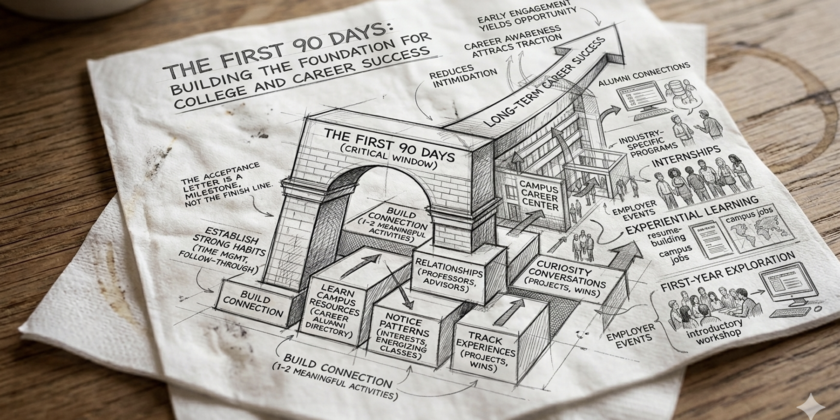
Research on the college transition often points to the first several weeks as a critical window. Students who build connections, learn how to use campus resources, and establish strong habits early are more likely to stay engaged and make the most of later opportunities. That doesn’t mean an incoming freshman needs a full career plan. They don’t. But it does mean families should start thinking earlier about how a student will use college, not just where they will go.
The acceptance letter is a milestone, not the finish line
Getting into college matters. It reflects years of effort, growth, and persistence. It is a real accomplishment and should be celebrated.
At the same time, admission is only the beginning. A college education is not simply a four-year academic experience. For most families, it is also a major financial investment tied to future opportunity. That’s why it helps to shift the conversation from “Where did my student get in?” to “How will my student make the most of this experience?”
College is not just a place to earn credits. It is also where students build relationships, experiences, and habits that shape future opportunities. Students who begin college with even a basic level of career awareness often gain traction faster. Not because they have everything figured out, but because they begin noticing what interests them, where they fit, and what experiences will help them build momentum.
The career center is not just for seniors
One of the most common myths on college campuses is that career services are for juniors and seniors ready to apply for jobs. In reality, the students who benefit most are often the ones who engage early. A first-year student does not need to walk into the career center and ask for a job. They can simply learn what is available. That might mean attending an introductory workshop, reviewing resources, or asking basic questions about resume-building, campus jobs, internships, alumni connections, or career exploration tools.
It’s also worth learning what platforms and systems the school uses. Does the college post opportunities through Handshake? Is there an alumni directory that students can access? Are there employer events, career fairs, or industry-specific programs first-year students can attend?
This matters even more now because many internship and recruiting timelines begin earlier than families expect. Students don’t need to start job hunting in their first semester, but they do benefit from understanding the landscape sooner rather than later. Early exposure also reduces intimidation. Students who wait until they urgently need help are often starting from scratch at the exact moment pressure is highest. Students who get familiar with available resources in the first semester are far more likely to use them when it counts.
Build a strong foundation without over-planning
The goal of the first 90 days is not to lock in a major, choose a career, and build a five-year plan. That’s too much pressure and usually not realistic. A better goal is to build a foundation that makes future choices easier and stronger. That foundation starts with a few simple habits.
First, encourage your student to choose one or two meaningful activities rather than joining everything. Depth matters more than a long list. A club, organization, volunteer role, student publication, research project, or campus job can all become valuable if the student is engaged enough to learn from it and contribute. These experiences also build something just as important as a resume line: a sense of belonging. Students who feel connected early are more likely to stay engaged, seek support, and hear about future opportunities.
Second, relationships matter early. Professors, advisors, resident assistants, older students, and campus staff can all become sources of insight and encouragement. Students don’t need a polished agenda. They just need to get comfortable asking questions, seeking guidance, and paying attention.
Third, students should begin noticing patterns. What classes are energizing? What problems do they enjoy solving? What kinds of people and environments bring out their best? Early self-awareness is often more useful than premature certainty.
Finally, it helps to keep track of experiences and accomplishments as they happen. One simple habit can pay off later: keep a running note of projects, responsibilities, software learned, problems solved, presentations given, and small wins along the way. Students rarely remember these details later, but they become the raw material for future resumes, LinkedIn profiles, networking conversations, and interviews.
Academic habits are part of career readiness
Parents often think of academic success and career readiness as two separate tracks. In reality, they’re closely connected.
The first semester is when students establish habits around class attendance, time management, help-seeking, and follow-through. Those habits affect grades, confidence, and stress levels. They also shape access to future opportunities. A strong GPA is not everything, but in some fields it matters. More broadly, students who learn how to manage college well are in a much better position to pursue internships, campus leadership, research, and networking later on.
That’s why the first 90 days are about more than career planning. They’re also about building the routines that make long-term progress possible.
Encourage curiosity conversations early
One of the most useful things a student can do in the first semester is start having what I call curiosity conversations. Networking can feel intimidating to a freshman. Curiosity conversations are a lower-pressure way to begin. These are informal conversations with alumni, older students, family friends, professors, or professionals in fields that sound interesting. The purpose is not to ask for a job or internship. It is simply to learn. What does this person do? How did they get there? What surprised them about college or work? What advice would they give someone starting out?
These conversations help students gain exposure to possible paths, build confidence talking with professionals, and understand how college experiences connect to real-world opportunities. Curiosity conversations are a low-pressure way to start building momentum.
What high school families should look for now
For families still making a final college choice, this is a good time to ask better questions about each school’s career ecosystem. Look beyond the admissions brochure. Ask about internship support, alumni engagement, access to employers, career center programming, experiential learning, and outcomes for students in different majors. A college’s value is not just about prestige or fit in the abstract. It is also about how well the school helps students translate education into opportunity.
What incoming students and parents should focus on next
For incoming college students, the message is simple: start with exploration, but be intentional. You don’t need to map out your life this summer. You do need to enter college ready to engage. Show up. Ask questions. Try things. Build a few relationships. Learn what support exists. Notice what fits. Keep track of what you do. Those early habits create options later.
For parents, this is also a mindset shift. During the admissions process, you may have needed to be more hands-on. Once college begins, your role works better as a guide than a manager. That means asking thoughtful questions, encouraging follow-through, and helping your student reflect without taking over.
Some students arrive on campus with plenty of ambition but little clarity on how to connect majors, activities, interests, and early career steps. That is normal. It is also where outside guidance can make a difference. Sometimes students benefit from structured support that helps them move from good intentions to a real plan.
The first 90 days matter, but progress matters more than perfection. Students do not need to get everything right immediately. What matters most is building a foundation early and making thoughtful adjustments along the way. The acceptance letter opens the door. What students do in the first 90 days helps determine how much they gain from walking through it.
—
Christine Rigby-Hall is the Founder of GradLanding, a coaching practice that helps college students and early career professionals build direction, confidence, and momentum in the internship and job search process.
If your student is heading to college with ambition but not much clarity about how to connect majors, activities, and early career steps, GradLanding offers practical support to help students build a stronger foundation from the start.
*Stay in the know! Subscribe*
 Staying organized and managing time
 Individualized skill-building based on each student’s strengths and needs
 Short-term, goal-focused sessions that fit into busy school schedules
 Flexible options for in-person or telehealth participation
 Convenient Upper East Side or available virtually