Guest Post! Beyond the Acceptance Letter: Why the First 90 Days of College Matter for Long-Term Career Success

Guest Post! Beyond the Acceptance Letter: Why the First 90 Days of College Matter for Long-Term Career Success

The deposit is paid. The college sweatshirt may already be ordered. For many families, late spring feels like the finish line after a long and demanding admissions process. But once the decision is made, a new question quickly takes its place: Now what?

This is where many families feel uncertain. They have spent so much time focused on getting into college that they’ve had little reason to think about what happens next. Yet the first few months of college shape far more than students realize. They influence confidence, habits, relationships, and the foundation for future internships and job opportunities.

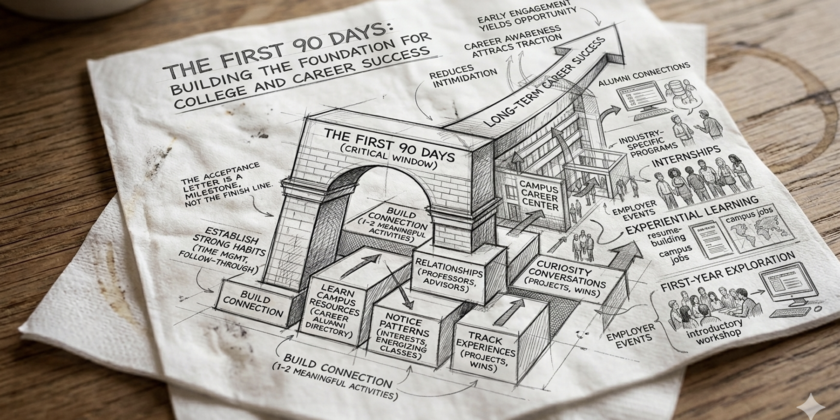
Research on the college transition often points to the first several weeks as a critical window. Students who build connections, learn how to use campus resources, and establish strong habits early are more likely to stay engaged and make the most of later opportunities. That doesn’t mean an incoming freshman needs a full career plan. They don’t. But it does mean families should start thinking earlier about how a student will use college, not just where they will go.

The acceptance letter is a milestone, not the finish line

Getting into college matters. It reflects years of effort, growth, and persistence. It is a real accomplishment and should be celebrated.

At the same time, admission is only the beginning. A college education is not simply a four-year academic experience. For most families, it is also a major financial investment tied to future opportunity. That’s why it helps to shift the conversation from “Where did my student get in?” to “How will my student make the most of this experience?”

College is not just a place to earn credits. It is also where students build relationships, experiences, and habits that shape future opportunities. Students who begin college with even a basic level of career awareness often gain traction faster. Not because they have everything figured out, but because they begin noticing what interests them, where they fit, and what experiences will help them build momentum.

The career center is not just for seniors

One of the most common myths on college campuses is that career services are for juniors and seniors ready to apply for jobs. In reality, the students who benefit most are often the ones who engage early. A first-year student does not need to walk into the career center and ask for a job. They can simply learn what is available. That might mean attending an introductory workshop, reviewing resources, or asking basic questions about resume-building, campus jobs, internships, alumni connections, or career exploration tools.

It’s also worth learning what platforms and systems the school uses. Does the college post opportunities through Handshake? Is there an alumni directory that students can access? Are there employer events, career fairs, or industry-specific programs first-year students can attend?

This matters even more now because many internship and recruiting timelines begin earlier than families expect. Students don’t need to start job hunting in their first semester, but they do benefit from understanding the landscape sooner rather than later. Early exposure also reduces intimidation. Students who wait until they urgently need help are often starting from scratch at the exact moment pressure is highest. Students who get familiar with available resources in the first semester are far more likely to use them when it counts.

Build a strong foundation without over-planning

The goal of the first 90 days is not to lock in a major, choose a career, and build a five-year plan. That’s too much pressure and usually not realistic. A better goal is to build a foundation that makes future choices easier and stronger. That foundation starts with a few simple habits.

First, encourage your student to choose one or two meaningful activities rather than joining everything. Depth matters more than a long list. A club, organization, volunteer role, student publication, research project, or campus job can all become valuable if the student is engaged enough to learn from it and contribute. These experiences also build something just as important as a resume line: a sense of belonging. Students who feel connected early are more likely to stay engaged, seek support, and hear about future opportunities.

Second, relationships matter early. Professors, advisors, resident assistants, older students, and campus staff can all become sources of insight and encouragement. Students don’t need a polished agenda. They just need to get comfortable asking questions, seeking guidance, and paying attention.

Third, students should begin noticing patterns. What classes are energizing? What problems do they enjoy solving? What kinds of people and environments bring out their best? Early self-awareness is often more useful than premature certainty.

Finally, it helps to keep track of experiences and accomplishments as they happen. One simple habit can pay off later: keep a running note of projects, responsibilities, software learned, problems solved, presentations given, and small wins along the way. Students rarely remember these details later, but they become the raw material for future resumes, LinkedIn profiles, networking conversations, and interviews.

Academic habits are part of career readiness

Parents often think of academic success and career readiness as two separate tracks. In reality, they’re closely connected.

The first semester is when students establish habits around class attendance, time management, help-seeking, and follow-through. Those habits affect grades, confidence, and stress levels. They also shape access to future opportunities. A strong GPA is not everything, but in some fields it matters. More broadly, students who learn how to manage college well are in a much better position to pursue internships, campus leadership, research, and networking later on.

That’s why the first 90 days are about more than career planning. They’re also about building the routines that make long-term progress possible.

Encourage curiosity conversations early

One of the most useful things a student can do in the first semester is start having what I call curiosity conversations. Networking can feel intimidating to a freshman. Curiosity conversations are a lower-pressure way to begin. These are informal conversations with alumni, older students, family friends, professors, or professionals in fields that sound interesting. The purpose is not to ask for a job or internship. It is simply to learn. What does this person do? How did they get there? What surprised them about college or work? What advice would they give someone starting out?

These conversations help students gain exposure to possible paths, build confidence talking with professionals, and understand how college experiences connect to real-world opportunities. Curiosity conversations are a low-pressure way to start building momentum.

What high school families should look for now

For families still making a final college choice, this is a good time to ask better questions about each school’s career ecosystem. Look beyond the admissions brochure. Ask about internship support, alumni engagement, access to employers, career center programming, experiential learning, and outcomes for students in different majors. A college’s value is not just about prestige or fit in the abstract. It is also about how well the school helps students translate education into opportunity.

What incoming students and parents should focus on next

For incoming college students, the message is simple: start with exploration, but be intentional. You don’t need to map out your life this summer. You do need to enter college ready to engage. Show up. Ask questions. Try things. Build a few relationships. Learn what support exists. Notice what fits. Keep track of what you do. Those early habits create options later.

For parents, this is also a mindset shift. During the admissions process, you may have needed to be more hands-on. Once college begins, your role works better as a guide than a manager. That means asking thoughtful questions, encouraging follow-through, and helping your student reflect without taking over.

Some students arrive on campus with plenty of ambition but little clarity on how to connect majors, activities, interests, and early career steps. That is normal. It is also where outside guidance can make a difference. Sometimes students benefit from structured support that helps them move from good intentions to a real plan.

The first 90 days matter, but progress matters more than perfection. Students do not need to get everything right immediately. What matters most is building a foundation early and making thoughtful adjustments along the way. The acceptance letter opens the door. What students do in the first 90 days helps determine how much they gain from walking through it.

Christine Rigby-Hall is the Founder of GradLanding, a coaching practice that helps college students and early career professionals build direction, confidence, and momentum in the internship and job search process.

If your student is heading to college with ambition but not much clarity about how to connect majors, activities, and early career steps, GradLanding offers practical support to help students build a stronger foundation from the start.

*Stay in the know! Subscribe*
Alumni Interviews

Alumni Interviews

Alumni interview season is here!

For many students, college admissions interviews are fear-inducing. Although there is some decent prep material online, you can often go right to the source for clarity on what the process entails. There is no reason to fear your alumni interview because many schools have their protocols and the guidance/instructions they give your interviewer available for you to review online—including possible interview questions.

You do not need to spend hours preparing answers to hundreds of questions to prepare for alumni or any other college admissions interview thoroughly. Canned responses sound unnatural. In my experience, taking the less stressful approach bodes well for students: they do not waste hours preparing, which can detract from other important tasks (homework, community engagement, application essays, sleep), and because they have not overprepared, they will sound far more natural and “themselves”—a goal for the IV process. 

Remember, so much of a college admissions interview (and this entire process!) is about likeability—rehashing your resume word-for-word does not make you likable, but being able to hold a conversation and do so with ease does! You’ll find some alumni IV resources below:

You can find a general list of potential interview questions in older posts, but contact us if you want individualized help preparing for your college interviews—alumni or otherwise—or want access to additional materials. We’ve helped hundreds of students ace their interviews and gain acceptance to their first-choice colleges and universities—don’t miss an opportunity to shine live!

*Stay in the know! Subscribe*

College Admissions Interviews

College Admissions Interviews

General interview prep questions below!

High School Experience

  • Tell me a little bit about your high school.
  • Tell me about the courses you are taking currently.
  • Tell me about your favorite class(es) you have taken. Why favorite(s)?
  • Which class has been your least favorite? Why?
  • Which classes have been the most difficult (or most challenging)?
  • What subjects do you plan on studying at [school name]?
  • What activities and/or classes have you taken part in related to that field?
  • What does your dream career look like, what is your dream job?

Extracurricular Activities

  • What extracurricular activities are you involved in?
  • What do you like to do for fun?
  • When you’re not in class, studying, or doing homework, what do you do with your time (organized activities or things for fun)?
  • How did you get involved/started with ____ activity?
  • What activity is the most meaningful to you and why?
  • What extracurricular activities do you hope to be involved with in college?
  • How have you spent your high school summers?

University Specific

  • What type of environment are you looking for in a college/university?
  • How did you become interested in [school]?
  • What do you find most appealing about [school]?
  • Why do you think you [school] might be the right fit for you?
  • Do you know any students at [school]?
  • If you had an opportunity to tell the Admissions Committee anything about yourself, what would it be? Why?
  • What would you want the Admissions Committee to know about you that may not come across on your application?
  • If I were to ask you to think back in three months to your visit to [school], what would be the first thing to pop into your head?
  • What have you learned about [school] that seems unusual or surprising?

Miscellaneous

  • If you got up and your best friend sat down, how would they describe you?
  • How would your teachers describe you?
  • If you had a year to do anything you wanted, what would it be and why?
  • What books are you currently reading? Or what have you read recently for school?
  • What has been a controversial issue at your school? What was your reaction, and how did you get involved?
  • Where have you made the biggest impact at your school or in your local community?
  • Where is your favorite place you have ever been? Why? Where would you like to go (if money and time were no object)?
  • Would you and where would you like to study abroad? Why?
  • What do you think is the most pressing issue of our time? Why?
  • What is your favorite book and why?
  • Is there anything we haven’t talked about that you wanted to talk about?

*Stay in the know! Subscribe*

Happy Women’s History Month 2023!

Happy Women’s History Month 2023!

GenHERation is hosting programming throughout March to energize and inspire their community. Over 50 leaders from 20+ companies will join them for a variety of fireside chats, panels, and skill-building workshops. 

These are great events for exploring careers in business, leadership learning, and so much more! 

The link to join virtual sessions will be sent via email on the morning of the scheduled event. Registration for virtual opportunities closes one hour before the session start time.

All participants in the WHM series will be entered into a lottery to win a Fossil watch and a virtual mentoring session with a Fossil team member! Participants will receive an additional entry in the lottery for each session they attend. 5 additional participants will also be selected via lottery to join a virtual mentoring session with the Fossil team. The winners will be announced on Friday, March 31, 2023.

Head to GenHERation for more info!

 *Stay in the know! Subscribe*

Want an Internship in High School? Try LinkedIn

Want an Internship in High School? Try LinkedIn

If you are a junior or sophomore and are looking to secure an internship it can help to get on LinkedIn. It’s one of the most convenient places to connect with potential employers, request informational interviews, and learn about the paths people have taken toward your dream role. There are many ways to get from high school to [insert dream role here]. It’s also faster than email in some cases!

It’s not hard to build a profile, and LinkedIn has published a guide just for high school students. You can access it here.

Some colleges also have a spot on their application to add a profile link; often, the more you can share about your interests, accomplishments, and goals, the better!

*Stay in the know! Subscribe*

MBA Admissions Events via Poets & Quants

MBA Admissions Events via Poets & Quants

Whether you’re exploring which degree is right for you, determining where to apply, or looking for ways to increase your chances of acceptance, Poets & Quants has tons of FREE events that can help clarify your next steps. Head to Poets & Quants for more information and to register. 

Top Entrepreneurship MBA Programs: January 10

Educate, inspire, spark, and embrace YOUR entrepreneurial spirit with Poets&Quants top-ranked MBA programs! Our unique content-based format gives real insight into the value of the MBA on the road to entrepreneurship.  Discover ways you can use your degree as an incubator for a startup!

Online MBA Admissions Event: January 24 & 25

You’re thinking about an MBA and like the flexibility, pacing, and price tag of online program options offered by many of the top business schools. This event will offer insight into different programs, help you understand the learning experience, and get advice to stand out in the application process.

CentreCourt Full Time MBA Festival: February 7 & 8

CentreCourt will host three events throughout the year to help full-time MBA seekers explore programs that align with professional and personal goals. If you want insider insights from leadership from top programs this is the event for you!

CentreCourt Business Masters Festival: March 14 & 15

This event series is for those exploring a Masters in Management, Finance, Business Analytics or other specialized business degree.  Through discussions with alumni, current students, admissions and career development teams, we invite you to join in to explore the benefits of specialization and to help determine which is the best fit for you, your skillset, and your career aspirations.

PreMBA Virtual Networking Festival: May 11 & 12

Are you starting a graduate business degree in 2023?  It’s never too early to forge important connections, become savvier about your internship and career options, and get a head start on your business school pivot. Meet with top employers and network with your peers from business schools all over the globe!

*Stay in the know! Subscribe*


College Admissions Interview Season!

College Admissions Interview Season!

For many students, college admissions interviews are fear-inducing. The good news is, you are already an expert on you, so all you need to learn is a little bit about the school and how to channel nerves into excitement.

Hear us out: You do not need to spend hours preparing answers to hundreds of questions to thoroughly prepare for alumni or any other college admissions interview. Canned responses sound terrible anyway. 

Remember, so much of college admissions (especially the interview) is about likeability—rehashing your resume word-for-word or sounding like a robot does not make you likable—but being able to hold a simple, genuine conversation does. 

Practice with a parent or friend, or practice for 30 minutes with us! Never go to an interview unprepared! Learning how to interview is a skill for life, not just for the college process. Email us if you are interested in a short mock interview session. 

Below, you will find some common interview questions.

High School Experience

  1. Tell me a little bit about your high school experience and the courses you are taking currently
  2. Which class has been your least favorite? Why?
  3. Tell me about your favorite class(s) you have taken. Why was it your favorite?
  4. Which classes have been the most difficult (or most challenging)?
  5. What subjects do you plan on studying at [school]?
  6. How have you pursued this interest in school and outside of school?

Extracurricular Activities

  1. What extracurricular activities are you involved in?
  2. When you’re not in class, studying, or doing homework, what do you do with your time (organized activities or things for fun)?
  3. How did you get involved/started with ____ activity?
  4. Which activity is the most meaningful to you, and which one is the most fun?
  5. What extracurricular activities do you hope to continue in college?
  6. If you could only continue taking part in one EC, which one would it be and why?

College Expectations

  1. What type of environment are you looking for in a college/university?
  2. Have you visited [insert college name]? What did you learn?
  3. What matters most to you in a college setting?

School Specific

  1. How did you become interested in [school]?
  2. What do you find appealing about [school]?
  3. Why do you think you [school] might be the right fit for you?
  4. Do you know any students at [school]? Have you reached out to them to learn more about [school]?
  5. If you had an opportunity to tell the Admissions Committee anything about yourself, what would it be? What would you want the Admissions Committee to know about you that may not come across on your application?
  6. What have you learned about [school] that seems unusual or surprising?

Miscellaneous

  1. How have you spent your high school summers?
  2. How would your best friend describe you?
  3. How would your teachers describe you?
  4. If you had a year to do anything you want, what would it be and why?
  5. What are you currently reading?
  6. Is there anything we haven’t talked about that you wanted to discuss?

 *Stay in the know! Subscribe*

Forté Fall Conferences

Forté Fall Conferences

Even in a pandemic, Forté’s mission of #MoreWomenLeading remains the same. Please join us in encouraging undergrad women to invest in their future selves by helping us spread the word about Forté’s upcoming virtual Fall College Conferences!

Forté Undergraduate Campus Leadership Summit
This is an opportunity for undergrad women to maximize their personal strengths and develop their unique leadership style. Open to sophomores, juniors, and seniors who are collegiate chapter student leaders, women in business club student leaders, and Forté Undergraduate Campus Ambassadors.

Sept. 30 – Oct. 1, 2021
Registration Deadline: Sept. 23

College Fast Track to Finance Conference
Open to sophomores and juniors of all majors interested in exploring the many career paths in finance. First-year students who are business majors or have previous experience and seniors that have not accepted full-time employment may also register.

Oct. 14-15, 2021
Registration Deadline: Oct. 1

Partners: PIMCO, Bank of America, Bloomberg, Credit Suisse, Deutsche Bank, Evercore, Greystar, Guggenheim Partners, Hines, J.P. Morgan, PNC, and Vanguard

Candid Conversations for Black, Latinx, and Native American Undergraduate Women Conference
Open to college women from historically underrepresented groups in business and diverse academic backgrounds — with a focus on the experiences of Black, Latinx, and Native American women.

Oct. 28-29, 2021
Registration Deadline: Oct. 15

Partners: PIMCO, Anheuser-Busch InBev, Bank of America, Bloomberg, Credit Suisse, DaVita, Deloitte, The Dow Chemical Company, Evercore, Hines, Liberty Mutual, UBS, and PNC

If you know a woman who would benefit from attending our virtual conferences, please send her this link: http://bit.ly/fortecc. You can also post the following on your social channels to help spread the word:

The business world needs more women leaders. Registration is now open for undergrad women to build leadership skills, expand their network, and develop their personal brand at Forté College Conferences this fall. Let’s get #MoreWomenLeading! http://bit.ly/fortecc.

Thank you for spreading the word about these events and Forté’s mission to get #MoreWomenLeading!

*Stay in the know! Subscribe*

February Action Plan – By Grade

February Action Plan – By Grade

Seniors:

  • Once your applications have been submitted, track the status of each app online to ensure all of your application materials were received. Follow up with your school counselor ASAP if a college is missing your transcript or a letter of recommendation. Check your junk email folder regularly (daily), so you do not miss correspondence from colleges.
  • Interviews! Sign up for interviews for all of your RD schools as soon as possible (where available/and if still open), if you have not done so already.
  • For RD schools, consider writing interest letters to schools that welcome additional information. It might even be beneficial to have an extra LOR sent if you did not send one within the Common App. 

Juniors:

  • Keep prepping for standardized tests (ACT, SAT) and working hard in all of your classes; your grades this year are very important.
  • Do you know what major(s) you will mark on your application? Do you have a clearly defined academic interest or set of interests for your college apps? This is a critical part of your application that should be determined now.
  • Continue working on your resume. Some summer programs, internships, and interviewers may ask for this, so it’s useful to have it handy.
  • Next summer is a wonderful opportunity to do something really meaningful, perhaps even fun, that will help you tell your story for college! Get those plans in place now.; there is still a lot of uncertainty because of COVID, so having multiple plans/irons in the fire is a good idea. 
  • Meet with your school counselor about your preliminary college list and go over your goals and plans for college visits/outreach.
  • Take a college tour via CampusReel. Visiting campus in person is great, but you won’t be able to tour all of the schools on your initial list. Plus, formal campus tours can be a bit limiting! CampusReel is one of my favorite ways to get a real insider look at colleges.
  • Tired of online tours? Sign up with one of our Peer Guides!!! 
  • Start to think about your senior year schedule. Do you know what you will be taking? Your senior classes should be the most challenging of your four years.
  • If you’d like to start your Common App essay early, now is the time. If you are not working with us and would like to on your essays, reach out via the contact form. We help quite a few juniors finish their CA essays over the winter/spring, especially those with busy summer/fall schedules. 

Sophomores and Freshmen:

  • An impressive academic record is the most important admissions factor at most colleges. Work on creating smart study habits this year.
  • Will you be starting your SAT or ACT prep this spring/summer? Begin to decide on a testing schedule and plan for how you will prepare for these exams.
  • Many 2021 summer program applications are now open. Please begin thinking about your plans for summer and work on applications if needed.
  • Start to think about next year’s course schedule. Do you know what you will be taking? Your classes next year should be more challenging than this year.
  • Now is the time to build your academic profile for college, and this means pursuing what interests you academically and intellectually outside of your classes. Have you gotten more involved with any academic extracurricular activities? Have you thought about what you might want to major in? Think about ideas for new and different activities or how to get more involved in your favorite activity (academic and non-academic); exploration now will help you begin determining what you might want to study in college. A great place to start exploring your academic interests is Khan Academy or TedX.
  • One way that your “story” is conveyed in your app is through your resume. Keep working on yours this month.

*Stay in the know! Subscribe*

Optional Components of the College Application

Optional Components of the College Application

If you want to maximize your chances of acceptance, don’t consider any optional components of a college application optional. Here are some common optional components:

  • Essays
  • Interviews
  • Videos submissions
  • Letter of recommendation (any or extras)

Option to write an optional essay? Write it.

Option to Interview? Sign up (then prepare for it…more on that here and here).

Option to create and send a video introduction, for example, like CMC, U Chicago and Bowdoin offer? Do it.

Option to send an extra letter of recommendation, or to send one at all if optional (many schools require zero LORs, so if you can submit one as an option….)? Request one and have it sent.

Why submit optional materials? It means you want to go above and beyond what other applicants will do to demonstrate who they are as well as their commitment to being accepted to the school to which you are applying. You are giving yourself the opportunity to let the admissions committee get to know more about you. More of “you” to evaluate, assuming the you that you present is in a good light, is usually a good thing.

Also, for many AdComs, not submitting optional materials looks lazy. If I have applicant A and applicant B on the table, and all things are equal but A submits extra materials and B does not, there is a higher likelihood I am going with A. I like to see the extra hustle, and colleges do, too.

*Stay in the know! Subscribe*