Guest Post! Beyond the Acceptance Letter: Why the First 90 Days of College Matter for Long-Term Career Success

Guest Post! Beyond the Acceptance Letter: Why the First 90 Days of College Matter for Long-Term Career Success

The deposit is paid. The college sweatshirt may already be ordered. For many families, late spring feels like the finish line after a long and demanding admissions process. But once the decision is made, a new question quickly takes its place: Now what?

This is where many families feel uncertain. They have spent so much time focused on getting into college that they’ve had little reason to think about what happens next. Yet the first few months of college shape far more than students realize. They influence confidence, habits, relationships, and the foundation for future internships and job opportunities.

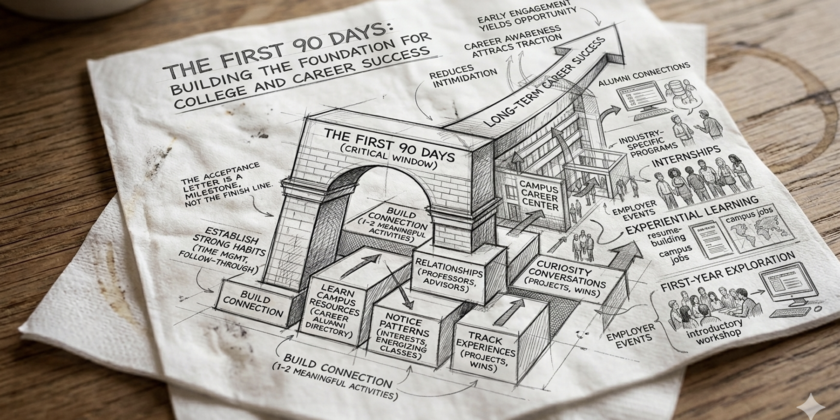
Research on the college transition often points to the first several weeks as a critical window. Students who build connections, learn how to use campus resources, and establish strong habits early are more likely to stay engaged and make the most of later opportunities. That doesn’t mean an incoming freshman needs a full career plan. They don’t. But it does mean families should start thinking earlier about how a student will use college, not just where they will go.

The acceptance letter is a milestone, not the finish line

Getting into college matters. It reflects years of effort, growth, and persistence. It is a real accomplishment and should be celebrated.

At the same time, admission is only the beginning. A college education is not simply a four-year academic experience. For most families, it is also a major financial investment tied to future opportunity. That’s why it helps to shift the conversation from “Where did my student get in?” to “How will my student make the most of this experience?”

College is not just a place to earn credits. It is also where students build relationships, experiences, and habits that shape future opportunities. Students who begin college with even a basic level of career awareness often gain traction faster. Not because they have everything figured out, but because they begin noticing what interests them, where they fit, and what experiences will help them build momentum.

The career center is not just for seniors

One of the most common myths on college campuses is that career services are for juniors and seniors ready to apply for jobs. In reality, the students who benefit most are often the ones who engage early. A first-year student does not need to walk into the career center and ask for a job. They can simply learn what is available. That might mean attending an introductory workshop, reviewing resources, or asking basic questions about resume-building, campus jobs, internships, alumni connections, or career exploration tools.

It’s also worth learning what platforms and systems the school uses. Does the college post opportunities through Handshake? Is there an alumni directory that students can access? Are there employer events, career fairs, or industry-specific programs first-year students can attend?

This matters even more now because many internship and recruiting timelines begin earlier than families expect. Students don’t need to start job hunting in their first semester, but they do benefit from understanding the landscape sooner rather than later. Early exposure also reduces intimidation. Students who wait until they urgently need help are often starting from scratch at the exact moment pressure is highest. Students who get familiar with available resources in the first semester are far more likely to use them when it counts.

Build a strong foundation without over-planning

The goal of the first 90 days is not to lock in a major, choose a career, and build a five-year plan. That’s too much pressure and usually not realistic. A better goal is to build a foundation that makes future choices easier and stronger. That foundation starts with a few simple habits.

First, encourage your student to choose one or two meaningful activities rather than joining everything. Depth matters more than a long list. A club, organization, volunteer role, student publication, research project, or campus job can all become valuable if the student is engaged enough to learn from it and contribute. These experiences also build something just as important as a resume line: a sense of belonging. Students who feel connected early are more likely to stay engaged, seek support, and hear about future opportunities.

Second, relationships matter early. Professors, advisors, resident assistants, older students, and campus staff can all become sources of insight and encouragement. Students don’t need a polished agenda. They just need to get comfortable asking questions, seeking guidance, and paying attention.

Third, students should begin noticing patterns. What classes are energizing? What problems do they enjoy solving? What kinds of people and environments bring out their best? Early self-awareness is often more useful than premature certainty.

Finally, it helps to keep track of experiences and accomplishments as they happen. One simple habit can pay off later: keep a running note of projects, responsibilities, software learned, problems solved, presentations given, and small wins along the way. Students rarely remember these details later, but they become the raw material for future resumes, LinkedIn profiles, networking conversations, and interviews.

Academic habits are part of career readiness

Parents often think of academic success and career readiness as two separate tracks. In reality, they’re closely connected.

The first semester is when students establish habits around class attendance, time management, help-seeking, and follow-through. Those habits affect grades, confidence, and stress levels. They also shape access to future opportunities. A strong GPA is not everything, but in some fields it matters. More broadly, students who learn how to manage college well are in a much better position to pursue internships, campus leadership, research, and networking later on.

That’s why the first 90 days are about more than career planning. They’re also about building the routines that make long-term progress possible.

Encourage curiosity conversations early

One of the most useful things a student can do in the first semester is start having what I call curiosity conversations. Networking can feel intimidating to a freshman. Curiosity conversations are a lower-pressure way to begin. These are informal conversations with alumni, older students, family friends, professors, or professionals in fields that sound interesting. The purpose is not to ask for a job or internship. It is simply to learn. What does this person do? How did they get there? What surprised them about college or work? What advice would they give someone starting out?

These conversations help students gain exposure to possible paths, build confidence talking with professionals, and understand how college experiences connect to real-world opportunities. Curiosity conversations are a low-pressure way to start building momentum.

What high school families should look for now

For families still making a final college choice, this is a good time to ask better questions about each school’s career ecosystem. Look beyond the admissions brochure. Ask about internship support, alumni engagement, access to employers, career center programming, experiential learning, and outcomes for students in different majors. A college’s value is not just about prestige or fit in the abstract. It is also about how well the school helps students translate education into opportunity.

What incoming students and parents should focus on next

For incoming college students, the message is simple: start with exploration, but be intentional. You don’t need to map out your life this summer. You do need to enter college ready to engage. Show up. Ask questions. Try things. Build a few relationships. Learn what support exists. Notice what fits. Keep track of what you do. Those early habits create options later.

For parents, this is also a mindset shift. During the admissions process, you may have needed to be more hands-on. Once college begins, your role works better as a guide than a manager. That means asking thoughtful questions, encouraging follow-through, and helping your student reflect without taking over.

Some students arrive on campus with plenty of ambition but little clarity on how to connect majors, activities, interests, and early career steps. That is normal. It is also where outside guidance can make a difference. Sometimes students benefit from structured support that helps them move from good intentions to a real plan.

The first 90 days matter, but progress matters more than perfection. Students do not need to get everything right immediately. What matters most is building a foundation early and making thoughtful adjustments along the way. The acceptance letter opens the door. What students do in the first 90 days helps determine how much they gain from walking through it.

Christine Rigby-Hall is the Founder of GradLanding, a coaching practice that helps college students and early career professionals build direction, confidence, and momentum in the internship and job search process.

If your student is heading to college with ambition but not much clarity about how to connect majors, activities, and early career steps, GradLanding offers practical support to help students build a stronger foundation from the start.

*Stay in the know! Subscribe*
CLA’s High School Internship Program

CLA’s High School Internship Program

Looking to explore the world of business, professional services, or accounting and gain hands-on experience with real projects and clients? Discover your passions and pave the way for your future career with CLA’s high school internship program. Applications for CLA’s High School Internship Program will be open soon.

This program helps students get a head start in considering career options, understand the opportunities available in professional services, and work on real projects. The 2026 high school internship program is an immersive, four-week paid program designed to inspire and grow the next generation of accounting and professional services talent.

Experience Dates: June 15 – July 16 (off the week of June 29 – July 3 off)
Workdays: Monday – Thursday (In Person)
Work Hours: 9am to 4:30pm local time
Attire: Business casual
Technology: All interns are assigned a laptop while in the program.

More information here!

*Stay in the know! Subscribe*


New Museum Teen Fellowship

New Museum Teen Fellowship

The NewMu Teen Fellowship is a paid, after-school program for New York City public high school students. The Fellowship spans two school years, allowing time for Fellows to develop their creativity, critical thinking, and self-expression. They work directly with professional artists, Museum staff, and community members and gain creative and professional development through mentorship, work experience, and leadership opportunities. The Fellowship amplifies youth voices and ideas by supporting large-scale projects, including a public display of their artwork and a Youth Summit.

The Fellowship meets weekly on Tuesdays, from 4 to 6pm, and will run from September 2025 through June 2027, excluding summer breaks and school recesses. Fellows are expected to commit to the full program, consisting of two school years.

Read more here and apply by May 18!

*Stay in the know! Subscribe*

Calling All Young Writers: Submit to the Adroit Prizes and the Summer Mentorship Program!

Calling All Young Writers: Submit to the Adroit Prizes and the Summer Mentorship Program!

For those looking to develop as a writer and work with a mentor…

Adroit is accepting applications from current high school students (including seniors!) for their online summer mentorship program through April 7th @ 11:59pm PT.

For guidance and answers to Frequently Asked Questions, please visit our Mentorship FAQ page.

For those with a polished piece of poetry or prose that’s ready for submission…the Adroit Prizes, awarded annually to two students of secondary or undergraduate status, are open for submissions.

The 2024 Adroit Prize for Poetry will be selected by Ocean Vuong; the 2024 Adroit Prize for Prose will be selected by Kaveh Akbar. The submission deadline for the 2024 Adroit Prizes is May 1st, 2024 @ 11:59pm PT.

If you would like to submit your work, please familiarize yourself with the submission guidelines.

*Stay in the know! Subscribe*

Best Summer Programs for High School Students: Law, Government, Politics, International Relations

Best Summer Programs for High School Students: Law, Government, Politics, International Relations

The following programs are some of our favorites for students interested in government, politics, law and IR.

Boys State/Girls State participants learn the rights, privileges and responsibilities of franchised citizens. The training is objective and centers on the structure of city, county and state governments. Operated by students elected to various offices, Boys State activities include legislative sessions, court proceedings, law-enforcement presentations, assemblies, bands, choruses and recreational programs. Legion posts select high school juniors to attend the program. In most cases, individual expenses are paid by a sponsoring post, a local business or another community-based organization.

The Benjamin Franklin Transatlantic Fellowship fosters relationships among the younger generation of Europeans and Americans to build strong linkages and an awareness of shared values. The Fellowship engages 45 teenagers from Europe and ten American teenagers (ages 16 – 18) in a four-week U.S.-based exchange program that aims to reinforce the transatlantic relationship. During the Fellowship, participants will explore transatlantic relations, leadership development, critical thinking, diplomacy, community activism, and the media in order to unite young adults around common goals, using the legacy of Benjamin Franklin as a framework. American youth are eligible to participate in the fellowship, but do not travel abroad. This fellowship is funded.

The United Nations Association of Greater Boston’s Summer Institute in Global Leadership offers week-long Model UN programs for students from all over the world to work together and address global issues. Learn about global issues, build skills for life and leadership, and collaborate with students from across the world during our week-long Model UN programs! In-person and virtual options.

The U.S. Department of State’s National Security Language Initiative for Youth (NSLI-Y) program provides critical language study overseas for U.S. high school students through full scholarships to participate in intensive summer and academic year programs. Participants study one of the eight NSLI-Y languages while immersed in the culture and day-to-day life of the host country. NSLI-Y is part of the National Security Language Initiative, a multi-agency U.S. government initiative launched in 2006 to improve Americans’ ability to engage with people from around the world. NSLI-Y plays an important role in preparing U.S. students for the 21st century’s globalized workforce and contributes to national security. NSLI-Y participants serve as citizen ambassadors, representing the diversity of the United States abroad and building lasting relationships with people in their host countries. If you have a passion for learning languages and want to immerse yourself in a foreign culture, this program may be for you! No previous language skills are required. NSLI-Y languages: Arabic, Chinese (Mandarin), Hindi, Indonesian, Korean, Persian (Tajiki), Russian, Turkish.

Onero Institute Virtual Teams. ​The Onero Institute produces high-level content on international affairs topics in new and creative ways. They develop projects specially designed for social media platforms to better engage young people on global issues and to bring credible content to an increasingly important space. Join the Virtual Engagement Team to take part in this unique area of today’s international discourse. If you would like to join but need more experience developing such projects, participate in the Virtual Engagement Program (VEP) to build up your skills in graphic design, concise writing, teamwork, and research.

The Edward M. Kennedy Institute for the United States Senate is dedicated to educating the public about the important role of the Senate in our government, encouraging participatory democracy, invigorating civil discourse, and inspiring the next generation of citizens and leaders to engage in the civic life of their communities. They now offer virtual programming.

Temple of Understanding Internship Program provides individuals with a hands-on learning experience of the work of the United Nations for four and a half intensive weeks. Students often discover their passion for a career in foreign affairs and related fields. Applicants are from different parts of the United States, as well as many other countries. Students accepted into this program have the opportunity to meet with different Missions and NGOs for discussions based on their specific questions and interests. Applicants are from different parts of the United States, as well as many other countries, and must be 17 years old by June 20 of the given Internship year.


Senate Page Program

Contact your senator’s office for more information on applying to be a Senate Page.

For Rising 9th Graders

The Summer Law Institute (SLI) is a five-week, summer law program for students who have just completed their eighth grade school year. The Summer Law Institute pushes rising ninth graders to see themselves as young professionals-in-training. The program exposes them to positive and successful role models, involves them in professional activities, and places them on a path that can lead to the fulfillment of their dreams. Students who complete the SLI are eligible to apply to our 4-year College Bound program.

Volunteer/Internship Opportunities:

Rock the Vote

US Department of Education

For the Many

*Stay in the know! Subscribe*


Best Summer Programs for High School Students: Math

Best Summer Programs for High School Students: Math

The following summer activities are some of our favorites for students interested in math.

Hampshire College Summer Studies in Mathematics (HCSSiM)

HCSSiM is an intensive six-week encounter with college-level mathematics for talented and highly motivated high school students. It is demanding and expanding. Participants spend a major portion of each day actively engaged in doing mathematics (not simply learning the results of mathematics). HCSSiM students live in the dorms at Hampshire College in Massachusetts for six summer weeks, and study and play in its fields, woods, and academic buildings (not typically in that order). Typically, there are as many girls and non-binary students as boys. The daily schedule includes 4 hours of morning classes (Mon-Sat), the pre-supper Prime Time Theorem, and evening problem sessions. Afternoons are devoted to reading, rest, recreation, occasional trips to town, and informal study. Participants have unparalleled access to faculty members in classrooms, at meals, and in the program dorm. Productive collaborations continue long after the program, and many lifelong friendships are forged.

MathILy

Do you want to explore and create mathematics? Then read on, for that’s what MathILy is all about! In MathILy classes, instructors provide the framework and you get to make (and prove!) the conjectures. You will encounter new ideas, improve your problem-solving skills, learn lots and lots of advanced mathematics, and hone your overall thinking skills. You’ll meet others like you. (Yes, really. We promise.) Most of all, you will find serious mathematics infused with levity. MathILy is five weeks of maximized mathematical marvelousness. MathILy is designed for students with an insatiable curiosity about mathematics and who are creative and enthusiastic in their approaches to learning. Participants come from all over the United States and, sometimes, the world.

Program in Mathematics for Young Scientists (PROMYS)

PROMYS is a six-week summer program in mathematics for strongly motivated high school students who are carefully selected from across the U.S. and around the world. Founded in 1989, PROMYS is a residential program held on the campus of Boston University with approximately 80 high school students and 25 undergraduate counselors. PROMYS is particularly interested in increasing diversity in mathematics and in science and technology opportunities more broadly. They strongly encourage students who are female, Black, Latino/a, or from other groups underrepresented in STEM to apply.

The Ross Program

The first year course in the Ross Program is organized around a series of daily problem sets in number theory. These sets invite the participants to contemplate a variety of seemingly simple questions about numbers and their relationships. As the summer progresses students are encouraged to investigate these questions in increasing depth, and to return to them periodically as their skill at abstract reasoning and their collection of available tools become more powerful. This spiraling of concepts is summarized in the Ross Program’s motto: “Think deeply about simple things.”Students should expect to get deeply involved in intensive, mathematical work. Although formal classes take up only eight hours per week, Ross participants work hard during the many hours of unstructured time. They think about the many mathematical problems, and struggle with the difficulties. After a lot of effort they finally develop methods of thought that will prove useful in many aspects of their scientific lives.

Stanford University Mathematics Camp (SUMaC)

Stanford University Mathematics Camp (SUMaC) welcomes a select group of rising high school juniors and seniors from around the world for intensive study in advanced mathematics. SUMaC leads participants on a journey in advanced mathematics through lectures, guided research, and group problem-solving. In an environment centered on mathematics, participants explore current lines of mathematical research, the historical development of important areas of mathematics, and applications across scientific disciplines. SUMaC is for students who have an exceptional interest in mathematics, and who are prepared for study of abstract algebra and number theory, or algebraic topology.  Similar to what they would experience in a college course, participants can expect a heavy and engaging workload of assignments to work on outside of the live class meeting times.

Summer Workshop in Math @ Duke University

Summer Workshop in Math (SWiM) is a free workshop for rising high school seniors who are interested in mathematics, with a particular focus on advancing female participation in math. SWiM is particularly interested in increasing diversity in mathematics and in science and technology opportunities more broadly, so SWiM strongly encourages students to apply who are female or gender minorities, who are in their junior year of high school, and who are citizens or permanent residents of and reside in the US if held online.

Canada/USA Mathcamp

Canada/USA Mathcamp is an immersive summer experience for mathematically talented students ages 13–18 from all over the world. It is an intensive 5-week-long summer program for mathematically talented high school students, designed to expose these students to the beauty of advanced mathematical ideas and to new ways of thinking. More than just a summer camp, Mathcamp is a vibrant community, made up of a wide variety of people who share a common love of learning and passion for mathematics. At Mathcamp, students can explore undergraduate and even graduate-level topics while building problem-solving skills that will help them in any field they choose to study.

*Stay in the know! Subscribe*

Best Summer Programs for High School Students: Sports Business/Management

Best Summer Programs for High School Students: Sports Business/Management

The following programs are some of our favorites for students interested in exploring different career paths in sports and the business of sports.

Quinnipiac: Modern Storytelling: Sports Journalism

Quinnipiac professors and sports journalism professionals champion this 1-week program for students to gain hands-on experience as sports journalists and develop an understanding of potential career opportunities. Attendees write, edit, record and produce sports stories both on and off campus while learning the basics of interviewing athletes and conducting press conferences.

ROC Nation Summer Sports Management Academy

New York City is home to one of the largest and iconic sports markets in the world, and the Roc Nation Sports Management Academy is at the center of it all! The Academy’s experiential learning model provides opportunities to explore what it’s like to sign an athlete, negotiate a deal, manage a venue, or run an athletic program. In addition to attending major sporting events, Academy participants study with industry leaders and professional athletes, learning how to translate a passion for sports into a flourishing career. Participants also have a unique opportunity to engage with the booming billion-dollar global eSports industry in LIU’s state-of-the-art eSports arena. This Academy inspires young students, athletes, entrepreneurs, and sports fans to become the next great sports industry professionals.

Isenberg Sport Management & Leadership Academy

McCormack’s summer Sport Management & Leadership Academy provides a platform for high school students to learn practical sport business applications and industry insights from our world-renowned faculty and industry-leading alumni. During this two-week program, students immerse themselves in key segments and critical issues relevant to the highly competitive sports and entertainment industry, such as:

  • Sport & Digital Media
  • Sport Marketing & Sales
  • Diversity & Inclusion in Sport Organizations
  • Player Performance & Data Analytics
  • Player Representation & Athlete Endorsement

Rawlings Sport Business Management Summer Institute

Three day online program ($100). Experiential-based learning. Students learn theory in the classroom, put theory to work in real-time projects, and present those projects back to industry professionals.

LIU Sport Marketing 

SPM 142 – Sports Marketing. This course focuses on the process of designing and implementing activities for the promotion and distribution of a sport product to a consumer. The principal steps in developing a marketing plan are outlined.

Global Sports and Entertainment Business Academy

The mission of Global Sports & Entertainment Business Academy is to provide all participants insight into the sports and entertainment industries. Our students will not only be introduced to a broad array of career opportunities, but they will also leave with a solid understanding of the business disciplines that constitute and contribute to the business such as management, advertising, sponsorship, technology, marketing, law, media, and other areas related to the sports and entertainment industries. Students will also practice leadership and teamwork as they engage in a variety of team-oriented activities.

Coursera/edX FREE Classes

Esports

Sports Sponsorship

Becoming a Sports Agent

Activism in Sports and Culture

*Stay in the know! Subscribe*

Best Summer Programs for High School Students: Engineering

Best Summer Programs for High School Students: Engineering

The following are some of our favorites for students interested in exploring engineering.

Lincoln Laboratory Radar Introduction for Student Engineers (LLRISE)

The LLRISE program is a two-week summer institute for rising seniors that teaches students how to build small radar systems. The project-based enrichment program challenges students to build a Doppler and range radar.

COSMOS UCSDUS IrvineUC Santa CruzUC Davis

The COSMOS program is a four-week residential program designed by the UC schools. Each campus focuses on different subject areas, all admitting their own “cluster” of students. The courses are taught by UC faculty and researchers. Students choose from nine different clusters, which include engineering design, biodiesel from renewable sources, tissue engineering and regenerative medicine, and more.

MIT Beaver Works Summer Institute

The MIT Beaver Works Summer Institute (BWSI) is a rigorous, world-class STEM program for talented students who will be entering their senior year in high school. The four-week program teaches STEM skills through project-based, workshop-style courses. BWSI began in 2016 with a single course offered to 46 students, a mix of local daytime students and out-of-state residential students. It is typically a 4-week residential program for rising high school seniors and the program is free. They also offer online courses.

National Institute of Standards and Technology (NIST) Summer High School Intern Program Research

NIST research is subdivided into six organizational NIST laboratories that conduct research in a wide variety of physical and engineering sciences. The labs respond to industry needs for measurement methods, tools, data, and technology. Six laboratories participate in the SHIP program.

Due to the multi-disciplinary nature of NIST’s research, students should look through the different websites above to discover a best-fit project area. The following information describes the types of research performed by each laboratory. See research projects done in previous years.

MIT Women’s Technology Program (WTP)

The MIT Women’s Technology Program (WTP) is a rigorous four-week summer academic experience to introduce high school students to engineering through hands-on classes, labs, and team-based projects in the summer after 11th grade. WTP is a women-focused, collaborative community aimed at empowering students from groups historically underrepresented and underserved in engineering. They especially encourage students to apply who will be the first family member to attend college, who come from high schools with limited access to STEM classes and activities, or who are African American, Hispanic, or Native American.

Minority Introduction to Engineering and Science (MITES)

The MITES program is a six-week-long residential program geared toward rising seniors from underrepresented or underserved communities. The program aims to provide the skills and knowledge necessary for pursuing a career in the STEM fields. Students take one math course, one life sciences course, one physics course, one humanities course and an elective course. Placement is determined by diagnostic tests that are administered to all students during the orientation period of the program.

AI Scholars

AI Scholars Live Online is a 10 session (25-hour) artificial intelligence bootcamp that exposes high school students to fundamental AI concepts and guides them to build a socially impactful project. Taught by a team of graduate students from Stanford, MIT, and more, students receive a personalized learning experience in small groups with a student-teacher ratio of 5:1.

HK Maker Lab, Columbia

The Hk Maker Lab is a summer engineering design program at Columbia Engineering that places high school juniors and seniors in pre-college, project-based courses with Columbia University faculty. This program is designed for students from backgrounds that are underrepresented in STEM and who have financial needs.

CATALYST Academy

CATALYST Academy is a one-week residential program for rising high school juniors and seniors from underrepresented backgrounds who desire to learn about engineering and careers within an interactive milieu.

Cooper Union Summer STEM

Summer STEM is an opportunity to try engineering for the first time or to dive deeper into engineering teamwork. Each 3- or 6-week class covers college-level topics and activities completed by The Cooper Union undergraduates in their first or second year or explores student and faculty research projects. Current high school students in grades 9, 10, 11 and 12 can apply.  This selective program encourages all curious, compassionate, and college-interested students to apply regardless of prior experience.

Manhattan College

The School of Engineering offers several programs throughout the year to introduce high school students to the field of engineering. Free or low cost.

Google Computer Science Institute (Summer Before COLLEGE!)

Google’s Computer Science Summer Institute (CSSI) is a three-week introduction to computer science (CS) for graduating high school seniors with a passion for technology — especially students from historically underrepresented groups in the field. CSSI is not your average summer camp. It’s an intensive, interactive, hands-on, and fun program that seeks to inspire the tech leaders and innovators of tomorrow by supporting the study of computer science, software engineering, and other closely related subjects. It is a 3-week program, and it is free.

*Stay in the know! Subscribe*

Best Summer Programs (+Other Extracurriculars) for High School Students: Business

Best Summer Programs (+Other Extracurriculars) for High School Students: Business

The following programs and other ECs are some of our favorites for students interested in business.

LEAD

Morgan Stanley JumpStart Scholars in Finance is a 5-month virtual, immersive learning experience designed to develop a pipeline of ambitious high-school seniors into the world of finance.

LEADing for Life GSLI REEX  is a residential program that will focus on developing a Pipeline of high-achieving, students (current high school juniors) by providing an immersive learning opportunity and preparation in Commercial Real Estate.

Fordham University, Various Programs

Young Women’s Business Institute (Kelley)

The Young Women’s Institute (free!) introduces young women to the college experience and business career opportunities. Students are selected from around the country to spend a week at Indiana University in Bloomington, Indiana. While at IU, students:

  • Participate in workshops with top Kelley School of Business faculty
  • Interact with Kelley alumni and current students
  • Prepare a real-world business case project
  • Build leadership and communication skills
  • Connect with like-minded women interested in business

TCU Investor Challenge

Are you a high school student entering your senior year? Apply for the TCU High School Investor Challenge®. [not yet updated for 2024; keep checking back at their site!]
The McCombs Summer High School Programs 
Free, six-day experiences focused on business and leadership that offer rising junior and senior high school students the chance to learn and interact with McCombs students, faculty, and corporate representatives. Outstanding African-American, Latino and Native American students, first-generation students, and students who have overcome social or economic hardship are strongly encouraged to apply. However, all students are welcome to apply.
Business Opportunities Summer Session (BOSS)
BOSS is a two-week in-person program held on Penn State’s University Park campus for high school students interested in pursuing a business education in college. It’s an opportunity for these students to take college prep and business fundamentals courses taught by Penn State faculty.  Sample schedule of what the two weeks would be like.
The University of Pennsylvania, Wharton
The Wharton School of the University of Pennsylvania hosts tons of paid programs and they are NOT posted here. Many of Penn’s past “selective” programs, like LBW, are now run by Summer Discovery and are not selective. We suggest these lower-cost and free options!

Wharton Global High School Investment CompetitionWharton Connect

Wharton Explore Business Mini-sites

Our Explore Business mini-sites are gateways to conversations, readings and activities that inspire high school students to think more deeply about issues affecting business and society. Dig into these Wharton-powered learning opportunities wherever and whenever you want to explore timely and compelling topics. Our mini-sites include:

Understanding Your Money is a self-paced online course for high school students. This course offers an introduction to fundamental economic concepts, investing, and basic money management to help you make smarter financial decisions. In addition to online video lessons delivered by Wharton faculty, the course includes links to related readings, activities and glossary terms, as well as quizzes to test students on what they have learned.

Non-“Program” Ideas We Love

Get a job!!! Wait tables, scoop ice cream, clean pools, landscape, construction, clean changeovers at hotels, grab a paper route — not glamorous, not always fun, but highly valuable.

Khan Academy Modules

Free Online Classes from Top Colleges & Universities

JUV Consulting

  • Gain experience with prototype testing and feedback, give your opinions and perspectives on trends, be a part of potential focus groups, contribute to school outreach programs, and participate in brand ambassadorship opportunities. Learn more here.

Learn Bloomberg and Financial Modeling via Excel

Internships and Shadows

  • Just about anything goes here, but getting one on your own might be preferred by some schools over shadowing a parent; getting a real job instead can also help balance this out!

*Stay in the know! Subscribe*

Best Summer Programs for High School Students: Science Research

Best Summer Programs for High School Students: Science Research

The following programs are some of our favorites for students interested in science/science research.

The Air Force Research Laboratory (AFRL) Scholars Program

The Air Force Research Laboratory (AFRL) Scholars Program offers stipend-paid internship opportunities for undergraduate and graduate-level university students pursuing STEM degrees, as well as upper-level high school students; select locations also offer internships to university students pursuing education-related degrees and K–12 professional educators. The selected interns gain valuable hands-on experiences working with full-time AFRL scientists and engineers on cutting-edge research and technology and are able to contribute to unique, research-based projects.

Anson L. Clark Scholars Program

Through this seven-week, intensive research program, 12 juniors and seniors will have the opportunity to participate in hands-on research in a variety of areas at Texas Tech University with faculty. Scholars receive room and board, and at the successful completion of a project report, they will earn a $750 stipend. In addition to research, scholars will participate in activities, seminars, and field trips.

Garcia Program, Stony Brook University

This is an intensive seven-week program for gifted high school students which combines formal instruction with independent research and allows students to design original research projects with guidance from Garcia Center faculty, students, and staff. Students can continue during the academic year in the Mentor Program, which allows them to plan a research schedule with a faculty mentor throughout the year. Pre-arranged transportation and class schedules are coordinated with local school boards to enable students from a large geographical area to enroll in the program. Almost three hundred high school students have participated in this program since its inception.

Research Science Institute, Massachusetts Institute of Technology

Each summer, 80 of the world’s most accomplished high school students gather at the Massachusetts Institute of Technology (MIT) for the Research Science Institute (RSI). RSI is the first cost-free to students, summer science & engineering program to combine on-campus coursework in scientific theory with off-campus work in science and technology research. Participants experience the entire research cycle from start to finish. They read the most current literature in their field, draft and execute a detailed research plan, and deliver conference-style oral and written reports on their findings. RSI scholars first participate in a week of intensive STEM classes with accomplished professors. The heart of RSI is the five-week research internship where students conduct individual projects under the tutelage of mentors who are experienced scientists and researchers. During the final week of RSI, students prepare written and oral presentations on their research projects.

NASA & CalTech Jet Propulsion Lab

NASA Office of STEM Engagement (OSTEM) paid internships allow high school and college-level students to contribute to agency projects under the guidance of a NASA mentor.

COSMOS, University of California (Multiple Campuses)

COSMOS is an intensive four-week summer residential program for students who have demonstrated an aptitude for academic and professional careers in science, technology, engineering and mathematics (STEM) subjects. Talented and motivated students completing grades 8-12 have the opportunity to work with renowned faculty, researchers and scientists in state-of-the-art facilities while exploring advanced STEM topics far beyond the courses usually offered in California high schools. Through challenging curricula that are both hands-on and lab intensive, COSMOS fosters its students’ interests, skills, and awareness of educational and career options in STEM fields.

Simons Summer Research Program, Stony Brook University

Established in 1984 as an outreach program for local high school students, the Simons Summer Research program now attracts applicants from all across the country to the Stony Brook campus: Simons Fellows are matched with Stony Brook faculty mentors, join a research group or team, and assume responsibility for a project. The Simons Fellows conclude their apprenticeship by producing a written research abstract and a research poster. In addition to learning valuable techniques and experiencing life at a major research university, Simons Fellows attend weekly faculty research talks and participate in special workshops, tours and events. At the closing poster symposium, students are presented with a $1,000 stipend award. Learn more here.

The Summer Science Program

SSP is not a “camp.” It is a unique immersion experience with a strong culture that has evolved over more than half a century. It is talented young people discovering their limits, then overcoming them through collaboration. It is the shock of not being the smartest person in the room, followed by the joy of realizing that’s not a problem, it’s an opportunity. In high school, teenagers learn about science. At SSP, they do science. That’s different! SSP is research, not coursework. Participants collaborate in teams of three. Everyone learns from – and teaches – everyone else.

Stanford SIMR

SIMR is an 8-week summer internship program open to high school juniors and seniors. The program consists of hands-on research under the direct guidance of a one-on-one mentor at a top class lab within the Institutes of Medicine at Stanford University as well as select departments.  Students applying to the program can choose from our eight areas of research (institutes). After being accepted, they are then assigned to a specific institute based on their choices.

Non-“Program” Ideas We Love

Khan Academy Modules

Free Online Classes from Top Colleges & Universities

Lab Internship/Shadow

  • Cold email! Ask your HS science teachers to help you connect with college labs!

*Stay in the know! Subscribe*