Guest Post! Beyond the Acceptance Letter: Why the First 90 Days of College Matter for Long-Term Career Success

Guest Post! Beyond the Acceptance Letter: Why the First 90 Days of College Matter for Long-Term Career Success

The deposit is paid. The college sweatshirt may already be ordered. For many families, late spring feels like the finish line after a long and demanding admissions process. But once the decision is made, a new question quickly takes its place: Now what?

This is where many families feel uncertain. They have spent so much time focused on getting into college that they’ve had little reason to think about what happens next. Yet the first few months of college shape far more than students realize. They influence confidence, habits, relationships, and the foundation for future internships and job opportunities.

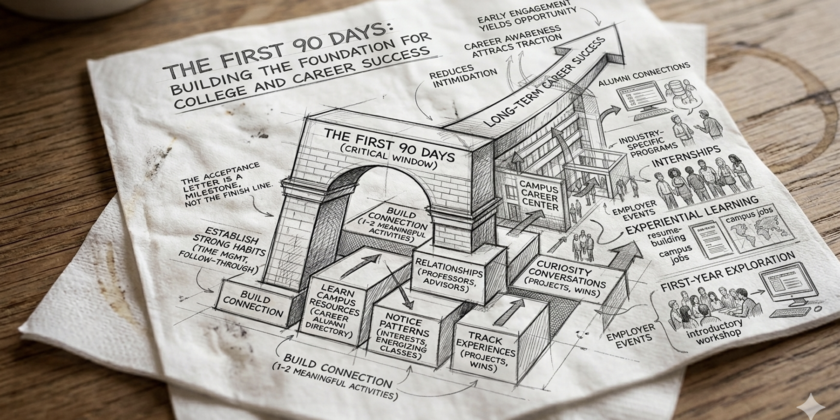
Research on the college transition often points to the first several weeks as a critical window. Students who build connections, learn how to use campus resources, and establish strong habits early are more likely to stay engaged and make the most of later opportunities. That doesn’t mean an incoming freshman needs a full career plan. They don’t. But it does mean families should start thinking earlier about how a student will use college, not just where they will go.

The acceptance letter is a milestone, not the finish line

Getting into college matters. It reflects years of effort, growth, and persistence. It is a real accomplishment and should be celebrated.

At the same time, admission is only the beginning. A college education is not simply a four-year academic experience. For most families, it is also a major financial investment tied to future opportunity. That’s why it helps to shift the conversation from “Where did my student get in?” to “How will my student make the most of this experience?”

College is not just a place to earn credits. It is also where students build relationships, experiences, and habits that shape future opportunities. Students who begin college with even a basic level of career awareness often gain traction faster. Not because they have everything figured out, but because they begin noticing what interests them, where they fit, and what experiences will help them build momentum.

The career center is not just for seniors

One of the most common myths on college campuses is that career services are for juniors and seniors ready to apply for jobs. In reality, the students who benefit most are often the ones who engage early. A first-year student does not need to walk into the career center and ask for a job. They can simply learn what is available. That might mean attending an introductory workshop, reviewing resources, or asking basic questions about resume-building, campus jobs, internships, alumni connections, or career exploration tools.

It’s also worth learning what platforms and systems the school uses. Does the college post opportunities through Handshake? Is there an alumni directory that students can access? Are there employer events, career fairs, or industry-specific programs first-year students can attend?

This matters even more now because many internship and recruiting timelines begin earlier than families expect. Students don’t need to start job hunting in their first semester, but they do benefit from understanding the landscape sooner rather than later. Early exposure also reduces intimidation. Students who wait until they urgently need help are often starting from scratch at the exact moment pressure is highest. Students who get familiar with available resources in the first semester are far more likely to use them when it counts.

Build a strong foundation without over-planning

The goal of the first 90 days is not to lock in a major, choose a career, and build a five-year plan. That’s too much pressure and usually not realistic. A better goal is to build a foundation that makes future choices easier and stronger. That foundation starts with a few simple habits.

First, encourage your student to choose one or two meaningful activities rather than joining everything. Depth matters more than a long list. A club, organization, volunteer role, student publication, research project, or campus job can all become valuable if the student is engaged enough to learn from it and contribute. These experiences also build something just as important as a resume line: a sense of belonging. Students who feel connected early are more likely to stay engaged, seek support, and hear about future opportunities.

Second, relationships matter early. Professors, advisors, resident assistants, older students, and campus staff can all become sources of insight and encouragement. Students don’t need a polished agenda. They just need to get comfortable asking questions, seeking guidance, and paying attention.

Third, students should begin noticing patterns. What classes are energizing? What problems do they enjoy solving? What kinds of people and environments bring out their best? Early self-awareness is often more useful than premature certainty.

Finally, it helps to keep track of experiences and accomplishments as they happen. One simple habit can pay off later: keep a running note of projects, responsibilities, software learned, problems solved, presentations given, and small wins along the way. Students rarely remember these details later, but they become the raw material for future resumes, LinkedIn profiles, networking conversations, and interviews.

Academic habits are part of career readiness

Parents often think of academic success and career readiness as two separate tracks. In reality, they’re closely connected.

The first semester is when students establish habits around class attendance, time management, help-seeking, and follow-through. Those habits affect grades, confidence, and stress levels. They also shape access to future opportunities. A strong GPA is not everything, but in some fields it matters. More broadly, students who learn how to manage college well are in a much better position to pursue internships, campus leadership, research, and networking later on.

That’s why the first 90 days are about more than career planning. They’re also about building the routines that make long-term progress possible.

Encourage curiosity conversations early

One of the most useful things a student can do in the first semester is start having what I call curiosity conversations. Networking can feel intimidating to a freshman. Curiosity conversations are a lower-pressure way to begin. These are informal conversations with alumni, older students, family friends, professors, or professionals in fields that sound interesting. The purpose is not to ask for a job or internship. It is simply to learn. What does this person do? How did they get there? What surprised them about college or work? What advice would they give someone starting out?

These conversations help students gain exposure to possible paths, build confidence talking with professionals, and understand how college experiences connect to real-world opportunities. Curiosity conversations are a low-pressure way to start building momentum.

What high school families should look for now

For families still making a final college choice, this is a good time to ask better questions about each school’s career ecosystem. Look beyond the admissions brochure. Ask about internship support, alumni engagement, access to employers, career center programming, experiential learning, and outcomes for students in different majors. A college’s value is not just about prestige or fit in the abstract. It is also about how well the school helps students translate education into opportunity.

What incoming students and parents should focus on next

For incoming college students, the message is simple: start with exploration, but be intentional. You don’t need to map out your life this summer. You do need to enter college ready to engage. Show up. Ask questions. Try things. Build a few relationships. Learn what support exists. Notice what fits. Keep track of what you do. Those early habits create options later.

For parents, this is also a mindset shift. During the admissions process, you may have needed to be more hands-on. Once college begins, your role works better as a guide than a manager. That means asking thoughtful questions, encouraging follow-through, and helping your student reflect without taking over.

Some students arrive on campus with plenty of ambition but little clarity on how to connect majors, activities, interests, and early career steps. That is normal. It is also where outside guidance can make a difference. Sometimes students benefit from structured support that helps them move from good intentions to a real plan.

The first 90 days matter, but progress matters more than perfection. Students do not need to get everything right immediately. What matters most is building a foundation early and making thoughtful adjustments along the way. The acceptance letter opens the door. What students do in the first 90 days helps determine how much they gain from walking through it.

Christine Rigby-Hall is the Founder of GradLanding, a coaching practice that helps college students and early career professionals build direction, confidence, and momentum in the internship and job search process.

If your student is heading to college with ambition but not much clarity about how to connect majors, activities, and early career steps, GradLanding offers practical support to help students build a stronger foundation from the start.

*Stay in the know! Subscribe*
Best Summer Programs for High School Students: Real Estate

Best Summer Programs for High School Students: Real Estate

The following are some of our favorites for students interested in real estate.

The Fordham Real Estate Institute

This summer, get a behind-the-scenes look at the many facets of the New York City real estate industry and learn what it takes to succeed in this fast-paced, high-income field. The Fordham Real Estate Institute offers high school students the opportunity to learn how real estate—the built environment in which we all live, work, and play—is designed, constructed, and developed. Through a mix of live lectures, hands-on exercises, and examinations of prominent New York City properties, students gain a unique perspective into the numerous college study and career options that the field of real estate offers. All courses are taught by experienced industry professionals from Fordham’s Real Estate Institute.

Real Estate NYC: From Design to Development Class (NYU)

Over one-third of the world’s wealth is invested in real estate, and more than nine million people in the United States work in the real estate industry. What goes on behind the scenes? What makes New York City among the most expensive real estate markets in the world? How does one get started in the field? Learn from top industry professionals during this one-week course offered by the NYU School of Professional Studies Schack Institute of Real Estate, one of the largest and most prestigious educational entities dedicated to the real estate and construction industries in the United States. Delve into all aspects of the real estate development process, and gain an understanding of the procedures, issues, and complexities that come into play in the development of real estate. Explore how real estate projects are conceived, designed, valued, financed, constructed, and managed. By week’s end, you will have gained an in-depth understanding of the phases of real estate development and the role that each sector of the industry plays in the process. Topics to be covered include the history of real estate design and development, the varying roles of members of the development team (architect, engineer, builder/CM, attorney), real estate underwriting metrics, valuation, project feasibility, design phase/construction phase considerations, sustainability measurements, and property and asset management.

NAIOP Commercial Real Estate High School Internship Program

The path to increased diversity in the commercial real estate industry begins with introducing teens to CRE prior to entering college. Students have the opportunity to explore a variety of careers in real estate, such as architecture, development, investment, construction, brokerage, and urban planning, through the lens of a case study and real estate–focused activities. Students gain a deeper understanding of key concepts in real estate by exploring these topics with Drexel University professors, industry mentors, and high-level corporate executives. The NAIOP-Drexel Summer Real Estate program features several team building, college readiness, and enrichment events on Drexel’s campus and throughout the city, including site visits to high-profile locations such as FMC and Comcast.

Online courses (free)

https://www.coursera.org/professional-certificates/keller-williams-real-estate-agent 

https://www.coursera.org/learn/the-principles-of-real-estate

https://www.coursera.org/learn/wharton-ai-application-insurtech-real-estate-technology

https://www.coursera.org/projects/deep-learning-for-real-estate-price-prediction

Online courses (not free)

Real Estate Finance (For Beginners)

Basic Real Estate Finance Course

Introduction To Real Estate Finance & Investing

Shadowing someone who works in real estate is also a great option; reach out about internships via LinkedIn. (yes, you can and should be on LinkedIn in high school!)

*Stay in the know! Subscribe*

Career Counseling

Career Counseling

Did you know that we offer 1:1 career coaching—guidance on crafting a killer resume and cover letter, networking, getting noticed on LinkedIn, identifying best-fit companies and roles, and preparing for interviews—for individuals in high school, college, and early in their careers who want to get strategic about meeting their professional goals?

Current offerings include:

  • 30-minute Career Q&A
  • Job Search Strategy Session
  • Interview Preparation Session
  • Resume/LinkedIn Review & Editing Package
  • Cover Letter Review & Editing Package
  • Hourly Ad-Hoc Services

We work with internship and job-seekers locally in New York City, as well as around the country and globe. If you are interested in learning more contact us.

 *Stay in the know! Subscribe*

3 Tips for Getting Started on LinkedIn

LinkedIn is one of the key social networks that employers today use to vet applicants and even seek them out through the platform’s recruiter tools. So, if you did not create one while you were applying to college, now is the time!

Building a comprehensive LinkedIn profile is a vital first step for setting yourself up for max exposure in your early career, and maintaining a presence on the site is just as crucial as you navigate career changes, pivots, launch new ventures, and make other notable moves.

Not everyone has time to use the more advanced features the site offers, but it is fairly easy to:

  • Keep your profile current! Sounds like a given, but when you’re busy with your job search or making career moves, it can be easy to forget. If there are only two things you always keep updated, make sure you have an accurate headline (current role) and location. Bonus points if your headline spices things up a bit. I can’t say mine does, but it would if I was looking for a new role.
  • Customize your public profile URL. Mine is https://www.linkedin.com/in/brittanymaschal. Fancy!
  • Use professional and accurate photos. If you are no longer 18, don’t have a picture of yourself from when you were 18. Now, this is likely not a huge deal if you are 22-26, but if you are 30, you should probably change it—I change mine every few years so when people meet me in person, they are meeting the current me, not the 20-something-year-old me. Also, no cropped shots where the shoulder of your best friend shows in the corner! Invest in a professional headshot, or have a friend take one that looks like a professional headshot. Including a simple but classy background photo or one that goes well with your “brand” is also a nice touch.

Want help setting up your LinkedIn profile as you apply for internships or full-time roles out of college? Contact us today!


*Stay in the know! Subscribe*


My Weekly Reads: Top 5


Awkward teens (and 20- and 30-somethings) rejoice. Study finds that it might take 63 years, but you will, eventually, shed all traces of your awkward middle-school self. (Fast Company)

Adderall usage by individuals without attention deficit is out of control. Fast Company reminds us we have the power to control our brains, sans meds. (Fast Company)

Diverse Hollywood, in NYC? Steiner Studio lot at the Brooklyn Navy Yard is surprisingly under the radar. It costs a third of most other film schools—$18,400 a year—and part of its mission is to admit women and minorities whose stories aren’t usually told. (New York Times)

And the award for the most unsatisfying industry to work in post-college goes to anything in finance (kind of). Meanwhile, in self-reported data from more than 13,000 recently graduated college students, such industries as technology, biotechnology, consulting, and arts, media, and entertainment top a list of “job satisfaction” ratings. Consulting -> we agree! (Poets & Quants)

Depression strikes today’s teen girls especially hard, and I see this firsthand in my work with high school students as they prepare and apply to college. Brains constantly “on-tech,” and in particular social media, may not be helping, but talking about it and identifying symptoms of depression early on can help teens get back on the right track. (NPR)

Is the Cover Letter Dead?


Repost from Grammarly:

The cover letter was once a valuable tool for all job seekers hoping to get by the HR gatekeeper. However, the rise of innovative tech, social media, millennials, and good old-fashioned networking is killing the cover letter.

The only thing missing from the decline of the cover letter is a time of death. In fact, chances are your cover letter won’t even be read, according to Fortune. Nearly 90 percent of hiring managers admit to never reading cover letters.

Interestingly, most job posts require a cover letter despite the unlikeliness of it getting more than a quick glance. Studies have found, however, that cover letters still get read if submitted with a resume.

The cover letter is as out of fashion as Hammer pants and Beanie Babies. Unless a cover letter is explicitly required, it is a waste of time and effort. Here’s why.

Your Social Media Accounts Are the New Cover Letter

It may not come as a surprise, but your social media presence is very accessible. Recruiters know this, and they will check out your profiles and activity. Social media is, in effect, the new cover letter, and at times the new resume.

This can be an advantage or a disadvantage, depending on your digital footprint. When recruiters want to know something about potential candidates, they simply Google them or check their Twitter accounts. Your Facebook photos are far more compelling and revealing about who you are compared to a thoughtfully scripted cover letter.

Old-Fashioned Networking Is Another Cover Letter Killer

Your cover letter may include all the traditional pleasantries, but there is always a more effective way to put your best foot forward. Networking is often far more effective than a cover letter.

In fact, 70 to 80 percent of jobs are never posted online, Matt Youngquist, president of Career Horizons, told NPR. This makes the cover letter a time-consuming effort with little return. Networking is possibly the best and fastest way to land the job you want.

Freelancers Have Saturated the Job Market

Companies large and small, including fresh startups, have all gone the route of the freelancer. Often, a cover letter is not part of the equation when hiring for contract positions.

An estimated 34 percent of the American workforce is composed of freelancers, according to a study conducted by the Freelancers Union. And this is expected to rise to 50 percent by 2020.

The wide range and availability of freelancers has made the cover letter irrelevant. Why bring in new employees on a salary when a freelancer will do the work on a project basis? Freelancers are often more economical for companies as well.

Professional Online Platforms = Recruiter’s Dream

If a recruiter needs to fill a position fast, why take the time reading endless cover letters? All the information they need is on a potential candidate’s professional online profile such as LinkedIn. In fact, nearly 93 percent of recruiters use LinkedIn to fill their company’s talent pool.

Professional online platforms like LinkedIn are not only killing the cover letter, but they are also putting the resume to rest as well. Many companies even permit potential candidates to apply for a job with their LinkedIn profile.

Don’t toss your cover letter just yet. There is still a place for it in your job hunt as it takes its last fleeting breaths of life. Though the cover letter is nearly dead, it is still required for the many jobs still posted online. However, focusing on your professional digital footprint more than your cover letter may prove to be time better spent.

Source

Doubts About Career Readiness From College Seniors

According to the results of a survey by McGraw-Hill Education, only 40 percent of college seniors say their experience in college has been very helpful in preparing them for a career. Not a great percentage if you ask me!

The third annual version of McGraw-Hill’s workforce readiness survey found a rise in the perceived importance of preparing for careers in college. While students report that they are increasingly satisfied with their overall college experience (79 percent in 2016 compared to 65 percent in 2014), an increasing percentage said they would have preferred their schools to provide:

  • More internships and professional experiences (67 percent in 2016 compared to 59 percent in 2014)
  • More time to focus on career preparation (59 percent compared to 47 percent)
  • Better access to career preparation tools (47 percent compared to 38 percent)
  • More alumni networking opportunities (34 percent compared to 22 percent)

From my experience, there are colleges that do a fantastic job regarding career services, those that do a poor job, and most fall somewhere in between. What I think many college students do not realize is that the services offered by college career centers/offices are not going to jump out and find them—they need to seek them out—and in most cases, they will need to supplement what’s offered on campus. Having a career or post-grad plan in place early on in one’s college career is helpful, and a way students can spend more time focusing on career preparation. Early career planning is one of our new focus areas, as students and their families have voiced their concerns and mirrored some of what the McGraw survey cited here points out.

What If the E! Network Covered Engineering?

The title of one of my favorite (recent) IHE articles. Funny (really, really funny), but the intent of the video the article cites is also serious. I loathe E! and every other celebrity gossip network, magazine, and so on. I sincerely wish that society placed more value on exploring intellectual interests, working toward meaningful careers, and pursuing work that positively impacts others and leaves the world a better place.

From the IHE article:

“This comedy video campaign seeks to challenge public stereotypes about engineers (what they look like, what they do and how they affect our lives), as well as strengthen the pipeline for those who want to pursue engineering,” said Amy Blumenthal, a spokeswoman for the USC engineering school, via email. “We would like people to understand that there is not one type of person who becomes an engineer, nor one type of engineer — and engineers make incredible impact.” The video is live this week as part of National Engineers Week.