Did you know that we offer 1:1 career coaching—guidance on crafting a killer resume and cover letter, networking, getting noticed on LinkedIn, identifying best-fit companies and roles, and preparing for interviews—for individuals in high school, college, and early in their careers who want to get strategic about meeting their professional goals?
Current offerings include:
30-minute Career Q&A
Job Search Strategy Session
Interview Preparation Session
Resume/LinkedIn Review & Editing Package
Cover Letter Review & Editing Package
Hourly Ad-Hoc Services
We work with internship and job-seekers locally in New York City, as well as around the country and globe. If you are interested in learning more contact us.
Our essay experts know best. Check out these 10 tips from Emma that will help you write the most effective personal statement. Summer is the best time to tackle this important essay, so start now! Interested in working with Emma? Contact us.
Don’t worry about the prompts. It’s helpful to read through the prompts to see if doing so sparks any ideas; however, there is no need to stress about writing an essay that exactly “answers” a prompt. Your goal is to write the best essay you can about whatever you decide is best to write about. Working with students 1:1, we totally disregard the prompts and usually find that their essay still easily fits under one of the questions. And, if not, there is often an open-ended prompt such as: “Share an essay on any topic of your choice. It can be one you’ve already written, one that responds to a different prompt, or one of your own design.”
Do open with a scene. A strong opening scene draws the reader into your essay. Admissions officers and their first-round readers have hundreds of applications to get through—make yours stand out from the first sentence. Intrigue them or scare them or make them laugh. Make them want to keep reading.
Do focus on a single story. You only have 650 words. Perhaps that sounds like a lot to you: it’s not. There is no reason you should worry about filling it up. Through our process, you will find out how to generate enough detail to write an essay about any story. Nor should you worry about cramming as much as possible into the personal statement. Remember that colleges have all of your application data and that trying to do too much in the essay will only end up making your essay feel rushed and scattered.
Do make sure that your story has a clear beginning, middle, and end. You can tell your story out of order—for instance, opening with a scene from a stressful moment in order to build suspense before jumping back into chronology—but you always want to make sure your story has each of these elements. Skipping any single one will confuse your reader and make your story feel incomplete (because it is!).
And yet don’t get bogged down in detail. We usually find students have trouble generating enough detail. But sometimes we get a student who is unable to summarize effectively, too. Having too much detail can make your story confusing and also mean that your reader will have trouble understanding what the most significant elements are. It usually also means you don’t have room for reflection—the most important element in the essay!
Do present yourself in a positive light. We actively encourage you to tell a story that showcases your vulnerabilities, failures, weaknesses, and mistakes. However, either your narrative or your reflection (or some combination of the two), needs to ultimately redeem you so that your essay, in the end, shows you to be someone who is actively working to improve—to rectify mistakes, move past failures, or strengthen weakness. Your essay should be honest, but its main purpose is to make you seem like someone admissions officers want to see at their colleges! Make sure you come off well.
Don’t use huge thesaurus words. Again: you aren’t trying to impress the admissions officers! You are trying to show them who you are—and you are trying to make them like you. Using big words can mean using words you don’t quite know how to use, and that will show. Even if you do know how to use them, unless your essay is about how much you love long words or languages, using the big, 25-cent words can make you sound pretentious and overly formal. The language should sound like you and be relatively casual—not curse-word, talking-with-friends casual, but maybe talking-with-your-grandmother casual.
Do use vivid, interesting words and varied sentence structure. Being casual doesn’t mean the writing shouldn’t be good or interesting! Do push yourself to use words you might not use in your everyday speech, and do mix up the sentence structure to keep the writing varied and exciting. Do feel free to include words from your personal vocabulary—words from the language you speak at home or from a regional dialect or words you’ve made up. That can add a lot of texture and personality to an essay. Just make sure you define the words for your reader if the meaning isn’t clear from context.
But don’t use emotional language: I was happy; I was sad. Instead, let an action depict the emotional state. That is, instead of saying “I was happy,” you might write, “I couldn’t help skipping a few steps down the street after hearing the news.” And, instead of saying “She was sad,” you might write, “Her shoulders slumped, and she cradled her head in her hands.” You can’t see an emotion, and you always want to give the reader something to see.
And don’t use cliche—i.e. common, predictable, overused—language. Cliche language includes (but is definitely not limited to!) phrases like:
I need to be true to myself.
Time heals all wounds.
Every cloud has a silver lining.
Good things come to those who wait.
I learned more from them than they did from me.
Every rose has its thorn.
You win some, you lose some.
Little did I know.
Of course, your essay might have one of these messages at its heart. Maybe you did learn more from the kid you tutored than they learned from you. Maybe you did find the “silver lining” in a terrible situation. Both of these could make for great essays. But you want to verbalize that realization in your own unique and surprising way.
Fellow IECA member Cigus Vanni is the master of lists. He created many that he shares with fellow IEC’s, and one sheds light on that almost no colleges continue to require or recommend the writing portion of the SAT or ACT. The biggest exception is the UC system, which still requires it.
Here’s his list as of 6/27:
Abilene Christian University (TX) – recommend
Albany College of Pharmacy and Health Sciences (NY) – recommend
Augsburg College (MN) – recommend (note: Augsburg is a test-optional school)
Berry College (GA) – require ACT, neither require nor recommend SAT
College of Charleston (SC) – recommend
Duke University (NC) – recommend
Eastern Illinois University – recommend ACT; neither require nor recommend SAT
Manhattan College (NY) – recommend; used for placement in writing courses, not for admission to school
Martin Luther College (MN) – require ACT, neither require nor recommend SAT
Michigan State University – recommend
Montana State University – recommend; used for placement in writing courses, not for admission to school
Oregon State University – recommend SAT; neither require nor recommend ACT
Rhode Island College – require ACT, neither require nor recommend SAT
Saint Anselm College (NH) – recommend (note: Saint Anselm is a test optional school)
Saint Norbert College (WI) – recommend
Shippensburg University of Pennsylvania – recommend
Soka University of America (CA) – require
State University of New York at Buffalo – recommend
Texas State University – recommend ACT
United States Military Academy (NY) – require
University of California Berkeley – require
University of California Davis – require
University of California Irvine – require
University of California Los Angeles (UCLA) – require
University of California Merced – require
University of California Riverside – require
University of California San Diego – require
University of California Santa Barbara – require
University of California Santa Cruz – require
University of Evansville (IN) – require (note: Evansville is a test optional school)
University of Mary Hardin Baylor (TX) – require
University of Minnesota, Twin Cities – recommend
University of Montana – recommend
University of Montana Western – require ACT, recommend SAT
VanderCook College of Music (IL) – require
Webb Institute of Naval Architecture (NY) – recommend
NOTE: All information current with the updating of this list on June 26, 2019. Be sure to check with each college to which you apply before you register for any standardized test as requirements can change.
For years, Valerie Strauss has published an annual summer reading list assembled by Brennan Barnard, the director of college counseling at the private Derryfield School in New Hampshire and college admission program manager of the Making Caring Common project of the Harvard Graduate School of Education. Barnard asks fellow high school college admissions counselors as well as college admissions deans for recommendations of books for students and parents to read. Some of the several dozen suggestions are related to the education world, and some are not.
I have my own reading list for this year, and I am excited to add a few from his list. I am currently reading The Moment of Lift: How Empowering Women Changes the World by Melinda Gates. It was a slow start for me, but I am glad I kept reading; there are some wonderful messages around unity, inclusion, and connection, and I have enjoyed learning about her early years at Microsoft, how she ramped up her work in their foundation, and even her relationship with Bill. I was not expecting to learn about their relationship at all! How she weaves together data and storytelling appeals to me, and I more now than before (which I did not think was possible) believe that when you lift up women, you lift up humanity. This book is a call to action if you did not feel compelled already.
I have also read the following books this year:
Boy Erased
Difficult Women
Brave, Not Perfect: Fear Less, Fail More, and Live Bolder
Fraternity
Becoming
To The Next Step
The Path Made Clear
And I will be adding the following from Barnard’s list to my list:
It seems that on almost every book list related to college, Julie Lythcott-Haims’ book is included, and I could not be more happy about that!!! I absolutely loved this book when I read it and its messages are as powerful and relevant today as they were in 2015. I suggest all parents read this book:
You are invited to find your dream job! GenHERation Invitationals are half-day career immersion programs that allow high school and college women to work alongside female executives at the most innovative companies in America. These events are your direct line to recruiters looking to hire talented young women for internships and full-time positions. Companies outline the applicant profile for available positions and we invite GenHERation members to apply in order to demonstrate their qualifications in person. Before each event, we share the candidates’ resumes with the companies and after the event we provide actionable next steps to continue the application process.
We will be announcing new invitationals every month and you can currently sign up for the following events:
Join us for our largest summer tour yet! GenHERation Discovery Days 2019 are immersive day trips that provide high school and college women with the opportunity to visit the most innovative companies in America. Participants will travel throughout a selected city by bus, which serves as an educational incubator complete with guided discussions by industry mentors. More than 50 companies are participating, including Ernst & Young, Capital One, Facebook, Netflix, Google, National Geographic, GSK, NFP, DLL, Expedia, Hartford Funds, Adobe, Nordstrom, Amazon, Microsoft, Twitter, Lucasfilm, NASA, IBM, Pizza Hut, Fossil, Pixar, CBS, Viacom, AllSaints, Bloomingdale’s, Urban Outfitters, the Philadelphia 76ers, and the Los Angeles Lakers.
Schedule
6/24: Dallas (SOLD OUT!)
6/26: Austin
7/8-7/9: Seattle (1 SEAT LEFT!)
7/10-7/11: Los Angeles
7/15-7/16: San Francisco
7/22-7/23: Charlotte
7/24-7/25: Washington, D.C.
7/31: New York City
8/1: Chicago
8/6: Philadelphia
Tickets are selling out fast! Reserve your seat HERE!
Life is not a contest, and the world is not an arena. Just by being here, unique among all others, offering contributions that no one else can give, you have already won the one prize that matters most.
I read an interesting Opinion piece in the Times the other day, that ended with the quote above. The title, “Let’s Hear It for the Average Child” confused me a bit, because there is nothing presented that shouts “average” to me, and I don’t see how being a student “whose talents lie outside the arena” makes one at all “average,” however average is defined (which is not clear in this piece).
But I “get it” and love the overarching message: you don’t need to be an award-winning, straight-A-getter, popular, all-subjects-enjoying, all-star athlete. Often, student’s whose gifts don’t translate to how society rewards them are the biggest “winners” of all.
It’s too bad we don’t more often—and outwardly—award students who are kind, compassionate, empathetic, self-aware, reflective and who have developed an understanding of how the world works on a deeper level. The students who get that it’s not all about their grades, or their resume, or where they go to college. In fact, it’s not even all about them.
I can’t wait for the day that colleges seek to measure and reward Margaret Renkl‘s “average” student. Until then, I’ll keep encouraging students to do the best they can in school but also to actively pursue their genuine interests, whatever they are, and engage with their communities (home, school, online, wherever they find and develop them!) in a positive and meaningful way. School is a central, significant part of your life in your teens and twenties, but it is not who you are, and it does not define you.
Summer is the best time to write your college application essays, and it’s a process you can and should start now!
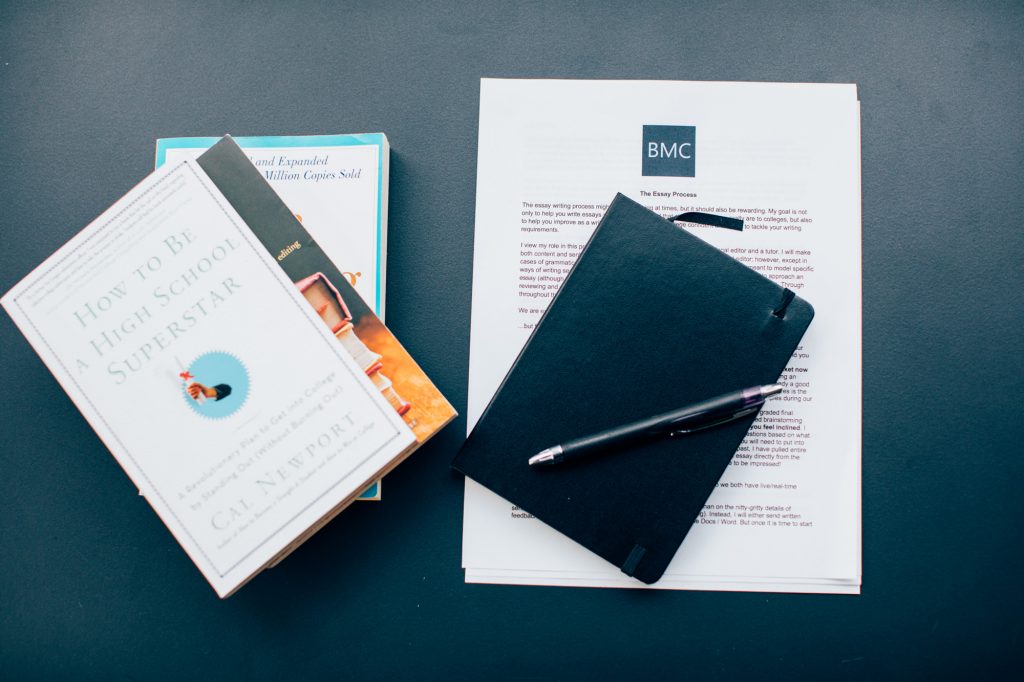
The essay writing process might be challenging at times, but it should also be rewarding. Our goal is not only to help students write essays they are proud of and that showcase who they really are to colleges but also to help them improve as writers, so they arrive at college confident and ready to tackle higher-level writing requirements.
Meet our essay experts:
Meet Emma: Emma grew up in NYC but left for Phillips Academy Andover, where she boarded all four years. Before starting at Harvard in 2008, Emma took a gap year during which she worked at a nonprofit in Ghana, taught English in South Korea, began learning Russian in St. Petersburg and took care of horses in the French countryside. At Harvard, she concentrated in Russian History and Literature, studying abroad in St. Petersburg, Russia for multiple summers; she graduated Phi Beta Kappa and summa cum laude. After graduation, she returned to New York and worked in book publishing for two years before attending the Iowa Writers’ Workshop as a poet, where she taught literature and creative writing. She has since taught composition at various universities, worked as a professional freelance editor, and privately tutored high school students in writing.
Meet Kris: A New Yorker born in Lithuania, Kris graduated from Harvard with a BA in economics, and completed his MFA in fiction at the Iowa Writers’ Workshop, where he received the top student and post-graduate fellowship funding, and where his thesis advisor was Pulitzer Prize winner Paul Harding. In between those two degrees, he worked in finance in Vietnam, started an education consulting company in China, and taught lawyers in Lithuania. His essays and photography have appeared in various outlets, including The Economist’s Intelligent Life magazine, The Browser and The Millions. He splits his time between New Mexico and New York and is working on a novel.
Want to work with Emma or Kris? Contact us to schedule a free, 30-minute consultation call and learn more about our essay process!
Until colleges start honestly looking for students who aren’t hyper-focused, I find myself having to make clear that students who drill down on their interests early on in high school will be better positioned to tell a clear, focused story in their college applications, and might have an advantage. Being well-rounded is fantastic, but colleges are looking for students with something unique, a specific talent, skill, goal, or interest to add to value to their next class. With a more focused application, you hand the reader of your file precisely what they are looking for—you make it easy to see your value add, and sadly, fit into one of the many boxes they try to place applicants in.
There are some other arguments toward being more narrow, focused. You may love all five (or more honestly, ten…) clubs you are in and the three sports you play, but how much can you meaningfully contribute to all of these activities? Chances are not that much, and by spreading yourself so thin, you’re not making much of an impact in any single one of them.
If you want to have a bigger impact, while at the same time create a profile that might be more appealing to admissions officers, try to narrow down your interests and corresponding activities by the end of 10th grade, and think about how you can engage more meaningfully and at a higher level in the one or two things you love the most. It’s a bonus if these activities relate to your potential college major, or support it in some way, as well as demonstrate a commitment to serving someone other than yourself. If you are not sure what that means or how that translates in a college app, email us.
Drilling down on your interests to develop a clear story or narrative for your college apps will go a long way in the admissions process, and is one of the focus areas of our college counseling work with high school students.
Remember, colleges seek to build a well-rounded class comprised of students with unique talents and skills, not a class full of unfocused students or generalists. If this changes, we will definitely be posting about it here!