Guest Post! Beyond the Acceptance Letter: Why the First 90 Days of College Matter for Long-Term Career Success

Guest Post! Beyond the Acceptance Letter: Why the First 90 Days of College Matter for Long-Term Career Success

The deposit is paid. The college sweatshirt may already be ordered. For many families, late spring feels like the finish line after a long and demanding admissions process. But once the decision is made, a new question quickly takes its place: Now what?

This is where many families feel uncertain. They have spent so much time focused on getting into college that they’ve had little reason to think about what happens next. Yet the first few months of college shape far more than students realize. They influence confidence, habits, relationships, and the foundation for future internships and job opportunities.

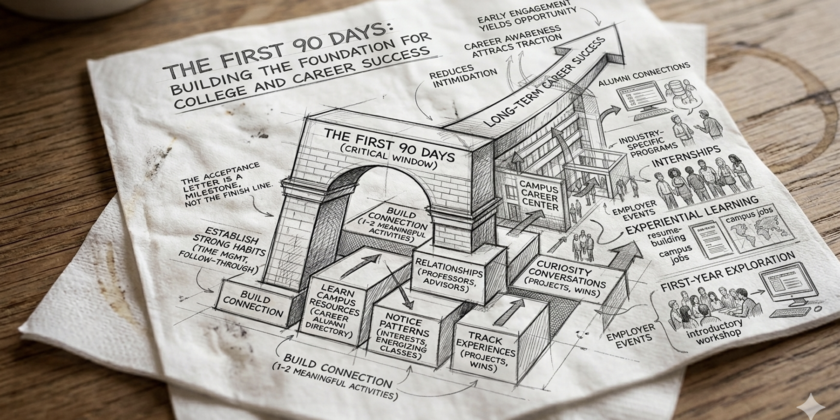
Research on the college transition often points to the first several weeks as a critical window. Students who build connections, learn how to use campus resources, and establish strong habits early are more likely to stay engaged and make the most of later opportunities. That doesn’t mean an incoming freshman needs a full career plan. They don’t. But it does mean families should start thinking earlier about how a student will use college, not just where they will go.

The acceptance letter is a milestone, not the finish line

Getting into college matters. It reflects years of effort, growth, and persistence. It is a real accomplishment and should be celebrated.

At the same time, admission is only the beginning. A college education is not simply a four-year academic experience. For most families, it is also a major financial investment tied to future opportunity. That’s why it helps to shift the conversation from “Where did my student get in?” to “How will my student make the most of this experience?”

College is not just a place to earn credits. It is also where students build relationships, experiences, and habits that shape future opportunities. Students who begin college with even a basic level of career awareness often gain traction faster. Not because they have everything figured out, but because they begin noticing what interests them, where they fit, and what experiences will help them build momentum.

The career center is not just for seniors

One of the most common myths on college campuses is that career services are for juniors and seniors ready to apply for jobs. In reality, the students who benefit most are often the ones who engage early. A first-year student does not need to walk into the career center and ask for a job. They can simply learn what is available. That might mean attending an introductory workshop, reviewing resources, or asking basic questions about resume-building, campus jobs, internships, alumni connections, or career exploration tools.

It’s also worth learning what platforms and systems the school uses. Does the college post opportunities through Handshake? Is there an alumni directory that students can access? Are there employer events, career fairs, or industry-specific programs first-year students can attend?

This matters even more now because many internship and recruiting timelines begin earlier than families expect. Students don’t need to start job hunting in their first semester, but they do benefit from understanding the landscape sooner rather than later. Early exposure also reduces intimidation. Students who wait until they urgently need help are often starting from scratch at the exact moment pressure is highest. Students who get familiar with available resources in the first semester are far more likely to use them when it counts.

Build a strong foundation without over-planning

The goal of the first 90 days is not to lock in a major, choose a career, and build a five-year plan. That’s too much pressure and usually not realistic. A better goal is to build a foundation that makes future choices easier and stronger. That foundation starts with a few simple habits.

First, encourage your student to choose one or two meaningful activities rather than joining everything. Depth matters more than a long list. A club, organization, volunteer role, student publication, research project, or campus job can all become valuable if the student is engaged enough to learn from it and contribute. These experiences also build something just as important as a resume line: a sense of belonging. Students who feel connected early are more likely to stay engaged, seek support, and hear about future opportunities.

Second, relationships matter early. Professors, advisors, resident assistants, older students, and campus staff can all become sources of insight and encouragement. Students don’t need a polished agenda. They just need to get comfortable asking questions, seeking guidance, and paying attention.

Third, students should begin noticing patterns. What classes are energizing? What problems do they enjoy solving? What kinds of people and environments bring out their best? Early self-awareness is often more useful than premature certainty.

Finally, it helps to keep track of experiences and accomplishments as they happen. One simple habit can pay off later: keep a running note of projects, responsibilities, software learned, problems solved, presentations given, and small wins along the way. Students rarely remember these details later, but they become the raw material for future resumes, LinkedIn profiles, networking conversations, and interviews.

Academic habits are part of career readiness

Parents often think of academic success and career readiness as two separate tracks. In reality, they’re closely connected.

The first semester is when students establish habits around class attendance, time management, help-seeking, and follow-through. Those habits affect grades, confidence, and stress levels. They also shape access to future opportunities. A strong GPA is not everything, but in some fields it matters. More broadly, students who learn how to manage college well are in a much better position to pursue internships, campus leadership, research, and networking later on.

That’s why the first 90 days are about more than career planning. They’re also about building the routines that make long-term progress possible.

Encourage curiosity conversations early

One of the most useful things a student can do in the first semester is start having what I call curiosity conversations. Networking can feel intimidating to a freshman. Curiosity conversations are a lower-pressure way to begin. These are informal conversations with alumni, older students, family friends, professors, or professionals in fields that sound interesting. The purpose is not to ask for a job or internship. It is simply to learn. What does this person do? How did they get there? What surprised them about college or work? What advice would they give someone starting out?

These conversations help students gain exposure to possible paths, build confidence talking with professionals, and understand how college experiences connect to real-world opportunities. Curiosity conversations are a low-pressure way to start building momentum.

What high school families should look for now

For families still making a final college choice, this is a good time to ask better questions about each school’s career ecosystem. Look beyond the admissions brochure. Ask about internship support, alumni engagement, access to employers, career center programming, experiential learning, and outcomes for students in different majors. A college’s value is not just about prestige or fit in the abstract. It is also about how well the school helps students translate education into opportunity.

What incoming students and parents should focus on next

For incoming college students, the message is simple: start with exploration, but be intentional. You don’t need to map out your life this summer. You do need to enter college ready to engage. Show up. Ask questions. Try things. Build a few relationships. Learn what support exists. Notice what fits. Keep track of what you do. Those early habits create options later.

For parents, this is also a mindset shift. During the admissions process, you may have needed to be more hands-on. Once college begins, your role works better as a guide than a manager. That means asking thoughtful questions, encouraging follow-through, and helping your student reflect without taking over.

Some students arrive on campus with plenty of ambition but little clarity on how to connect majors, activities, interests, and early career steps. That is normal. It is also where outside guidance can make a difference. Sometimes students benefit from structured support that helps them move from good intentions to a real plan.

The first 90 days matter, but progress matters more than perfection. Students do not need to get everything right immediately. What matters most is building a foundation early and making thoughtful adjustments along the way. The acceptance letter opens the door. What students do in the first 90 days helps determine how much they gain from walking through it.

Christine Rigby-Hall is the Founder of GradLanding, a coaching practice that helps college students and early career professionals build direction, confidence, and momentum in the internship and job search process.

If your student is heading to college with ambition but not much clarity about how to connect majors, activities, and early career steps, GradLanding offers practical support to help students build a stronger foundation from the start.

*Stay in the know! Subscribe*
Focus on the next fours years, not the last.

Focus on the next fours years, not the last.

The class of 2022 is resilient. They’ve weathered a pandemic, the confusion of test-optional, okay at best online schooling—the list goes on. 

Great read in Charter by S. Mitra Kalita. “Bottom line: You’re going to be fine. Let’s focus on the next fours years, not the last!”

*Stay in the know! Subscribe*


June Monthly Action Plan – By Grade

June Monthly Action Plan – By Grade

What a month! We took a break on the blog from June 1-8, and we are now back with our regularly scheduled programming. Please find the June MAP below, and be sure to reach out to us via the contact form is you have specific questions about what you or your student can be working on this month.

Seniors

  • Congrats, grads! If you love graduation speeches as much as me, check out a few of my favorites as you celebrate this amazing accomplishment:
        • George Saunders, Syracuse (takeaway: regretting failures of kindness – be kind)
        • Steve Jobs, Stanford (takeaway: stay hungry, stay foolish, listen to and follow your heart)

Juniors

  • Obtain and review your final transcript (all grades from 9, 10, 11) ASAP after grades post. This is important so you can have your school correct any errors, and so you know exactly what colleges will see when they get your transcript.
  • Now is an excellent time to start thinking about your application strategy. Even if you are not finished with testing, you’ll want to complete applications this summer.
  • It might seem like a silly piece of advice, but many students are not aware that every college has a set of application instructions that are not located on the online application. Locate and read them for every school on your list before tackling the application process. 
  • Colleges may not open for tours before you submit early applications (in October or earlier). Spend time taking virtual tours and connecting with and learning about colleges in other ways (reaching out to current students and alumni is just one example!).
  • As you begin writing essays this month, open a Common App account and begin filling out the base data (Profile, Family, Education, Testing, Activities).
  • Many colleges don’t proactively ask for online resources, but you may have an interest in creating a digital portfolio (LinkedIn, SoundCloud, GitHub, YouTube channel, personal website, and/or blog) to supplement your other application materials. 

Sophomores & Freshmen

    • Work on a purpose project this summer!
    • A purpose project is one that you design and implement (with our help if you’d like!), which taps into your interests and talents (the things you love, that bring you joy, that you want to study in college, or that you feel could best help your school, community, or the world); it is connected to a deeper purpose and has tangible outcomes that you set.
    • Past projects from students include writing a children’s book, completing a literature review or book challenge, creating a trailer for a documentary (and founding a non-profit, a school club, an app), spearheading an innovative volunteer event, fundraising for an organization in a creative way (selling artwork, an Etsy shop, etc.), and hosting a yearly beach clean-up. The possibilities are endless, and colleges love seeing students take part in meaningful, self-directed work.   

 *Stay in the know! Subscribe*

Social Media Break, Graduation & Summer Reading/Listening

Social Media Break, Graduation & Summer Reading/Listening

From June 1-8 we took a break from posting on social media. During that time, we continued to think about and act on ways to support our community.

This is the time of year that we are sending congratulations to our high school grads, the class of 2020. In lieu of graduation gifts, we’ve made a donation in their honor to Rock The Vote. Rock the Vote aims to register and educate millions of young voters, be a trusted source of information, and ultimately empower young people to use their voices and create the political and social change that they believe in. We support their dynamic programming, including high school civic education, voter protection work, and election efforts. We have also supported Mutual Aid NYC, a community of volunteers supporting mutual aid organizing across the city, including the Brooklyn Bail Fund.

June is also Pride Month, and this year is the 51st anniversary of the Stonewall Riots. Our friends at the podcast Footnoting History put together a wonderful list of resources. I welcome you to listen to their episodes on Black HistoryUS History, and LGBT History. You might also want to check out:

One of the most powerful ways to speak is to amplify the voices of those with deeper understanding and broader data; accordingly, Adam Grant suggests the following books:

When members of our community hurt, we all hurt. Let’s all be part of the change.

*Stay in the know! Subscribe*

Career Counseling

Career Counseling

Did you know that we offer 1:1 career coaching—guidance on crafting a killer resume and cover letter, networking, getting noticed on LinkedIn, identifying best-fit companies and roles, and preparing for interviews—for individuals in high school, college, and early in their careers who want to get strategic about meeting their professional goals?

Current offerings include:

  • 30-minute Career Q&A
  • Job Search Strategy Session
  • Interview Preparation Session
  • Resume/LinkedIn Review & Editing Package
  • Cover Letter Review & Editing Package
  • Hourly Ad-Hoc Services

We work with internship and job-seekers locally in New York City, as well as around the country and globe. If you are interested in learning more contact us.

 *Stay in the know! Subscribe*

Incoming or Current College Student? Get Started with Career Counseling

Did you know that we offer 1:1 career coaching—guidance on crafting a killer resume and cover letter, networking, getting noticed on LinkedIn, identifying best-fit companies and roles, and preparing for interviews—for individuals in high school, college, and early in their careers who want to get strategic about meeting their professional goals?

Current offerings include:

  • 30-minute Career Q&A
  • Job Search Strategy Session
  • Interview Preparation Session
  • Resume/LinkedIn Review & Editing Package
  • Cover Letter Review & Editing Package
  • Hourly Ad-Hoc Services

We work with internship and job-seekers locally in New York City, as well as around the country and globe. If you are interested in learning more contact us.


 *Stay in the know! Subscribe*

Off to College

Congrats to the graduates of the high school Class of 2019!

Here’s where our ’19 grads—who hail from 3 continents and 8+ states across the US—are headed this fall:

Berkeley

Boston College

Brown

Cal Poly SLO

Colby (2)

Cornell (3)

Dartmouth

Duke

Edinburgh (2)

Elon

Fordham

George Washington University (3)

Georgetown (2)

Lehigh

Rollins

Princeton

The University of Massachusets, Amherst

The University of Miami (2)

The University of Michigan (3)

The University of Minnesota

The Ohio State University

The University of Pennsylvania

The University of Washington

UCLA (2)

Vanderbilt


Congrats!!


*Stay in the know! Subscribe*


Congrats Class of 2019! And Some Advice

Photo by Vasily Koloda on Unsplash

As graduation nears and high school comes to a close, first and foremost, take time to soak it all in and enjoy yourself! Graduation signifies exciting new beginnings, but also change. Many of the people you are used to seeing every day at your high school are people you might not see often (or again in some cases), so make the most of spending time with them, and your family, this summer.

While you are relaxing with the people you care about most, don’t forget to say thanks where thanks is due. It can be easy to forget the many individuals who were there every step of the way during your application journey, supporting and guiding you towards college. Take some time to thank the people who helped you along the way by writing them a thank you note or giving a heartfelt thanks in person.

People to thank: parents, guidance counselor, teachers, letter of recommendation writers, anyone else who read your essays/app, college admissions officers you met with, and tutors just to name a few!

Also, make the most of this summer!!! Consider an internship or job. You’ll need money in college; a job is where the money comes from. Beyond having some much-needed cash, one Stanford researcher even found that having a summer job can boost academic performance, and more: “adolescent employment can foster noncognitive skills like time management, perseverance, and self-confidence.” Moreover, once you are in college you’ll need to be 100% independent, just as you will need to be at work. Prep now and be ready for those more significant pre-professional experiences as an undergrad.

But what type of job should I get? I suggest something fun like scooping ice cream, or better yet, waiting tables. As Rob Asghar notes, waiting tables “can be the high-pressure arena in which many talented people learn how to take control of their lives and prosper over the long haul.”

“I think everyone should spend some time waiting tables or working in retail,” Elisa Schreiber, a marketing executive in Silicon Valley, tells me.

“I learned so much by waiting tables,” says Schreiber, a longtime colleague who happens to be one of the savviest strategists and leaders I’ve ever worked alongside. “I learned empathy and understanding and compassion. I learned how to get people in and out while still feeling good about their experience. It made me exponentially better when I started my salaried, professional career—from leading people to handling pressure to effectively managing my time.”

It is not glamorous (I know, I did it for the better part of a decade in high school, college, and grad school), but it is a learning experience, to say the least. I also suggest getting on LinkedIn. See this post for tips on getting started.


 *Stay in the know! Subscribe*